Friday, 18 November 2011

Day 48 : Bow : Dhanurasana ( bow ) subroutine from Vinyasa Krama Bow sequence

VIDEO LINK

Asymmetric Dhanurasana
Get a grip during exhalation
Pause for a breath
Pull in your leg on the next inhalation
Relax on the exhalation
Repeat three to six times
Pause for a breath after the final exhalation

Dhanurasana
Reach back and catch both legs on the exhalation
Drawin in the legs on the inhalation
Relax on the exhalation
Repeat three to six times.

Ideally the feet knees, thighs will stay together although in the beginning it's acceptable if not preferable to allow them to to be a few inches apart.

Drishti (gaze) look straight ahead.

HINTS/TIPS/SUGGESTIONS

Engage Mula and uddiyana bandha, imagine there is a pea beneath you belly that you are trying not to squab by daring in your belly throughout.

Rather than lifting for the leg or pulling in there is a stretching through the whole body. Because the hand and foot are bound this stretch arches the back and lifts the chest and leg.

drop the shoulder blades down the back  to allow the chest to lift more easily and to relax the neck.

In the asymmetric version, ground the whole trailing leg pressing into the mat from the hip to the toes

NB: These are practice notes that will be tidied up and put into the new edition of my Vinyasa Yoga Practice Book along with the current sequences and subroutines. The book can be freely downloaded HERE. There is a page on Facebook HERE with all the latest sheets and updates. This book is in no way a substitute for Ramaswami's Complete Book of Vinyasa Yoga.

Thursday, 17 November 2011

Day 47 : Bow : Salabhasana (locust) subroutine from Vinyasa Krama Bow sequence

VIDEO LINK
HINTS/TIPS/SUGGESTIONS

Regular Salabhasana

As Day 46 (Asymmetric Salabhasana ), There's a tendency to lift the leg from the foot but activate the buttock and begin to lift from the head of the femur itself rotating it up in the hip socket, along with the thigh, the knee the calf and the foot, lift the whole leg.

Stretch through the length of the leg

At the end of the inhalation give the hip a little nudge upwards while pushing the other hip into the mat.

As with the leg, rather than just lifting the arm stretch right through the arm from the shoulder to the hand


Stretch through both the arm and the leg, tho seems to make them lighter as if they want to float up.

In all these postures stretch through the back lifting out of the pelvis to give space for the arch of the back.

Ground the pelvis into the mat.

Viparita Salabhasana VIDEO LINK

In the Vinyasa Krama version of this posture the hands are clapped together under the groin.

We can begin to explore this posture by placing a towel under our shoulders to take some of the pressure of out throat, which can feel strange and uncomfortable in the beginning.

It's possible to take the legs up together, in the video i walk the legs in as far as possible and then push off with one leg while leading with the other.

As you legs go up the back will need to arch to catch the feet at the top of the ark.

Stretch firmly through the whole length of the legs from the pelvis to the toes.

Keep the legs straight and take the feet  beyond the head to find a point of balance where the weight of the feet counteracts the weight of the pelvis

Press the full length of the arm firmly into the mat

There is the fear of flipping over, although this is highly unlikely in Viparita Salabhasana you may wish to practice near a wall as in the video. (This will also allow you the option of walking down the wall when beginning to work on the next posture Gandha Bherundasana.

Here's a link to a video showing the use of the towel http://youtu.be/xwDSQyjBl8chttp://youtu.be/xwDSQyjBl8c


Gandha Bherundasana VIDEO LINK

In this challenging posture a development of Viparita salabhasana we seek to bring the fee to the head. This may take some time to achieve.

The trick is to drop the hips  to bring the feet lower

We also need to create more of an arch in the back. To do this take your feet further beyond your head in Viprita Salabhasana, the increased counterweight will allow you to drop your chest a little lower towards the mat creating a deeper backbend.

The temptation is to bring the feet in towards the head by bending at the knee but try to stretch through the full length of your legs as you bend at the knee.

The tendency is to focus on the lower half of the body but still try to stretch through the full length of the spine as if your still lifting out of the pelvis. Although the upper body won't move it will seem to create space in the spine and sacrum allowing your to arch the back more comfortably.

NB: These are practice notes that will be tidied up and put into the new edition of my Vinyasa Yoga Practice Book along with the current sequences and subroutines. The book can be freely downloaded HERE. There is a page on Facebook HERE with all the latest sheets and updates. This book is in no way a substitute for Ramaswami's Complete Book of Vinyasa Yoga.

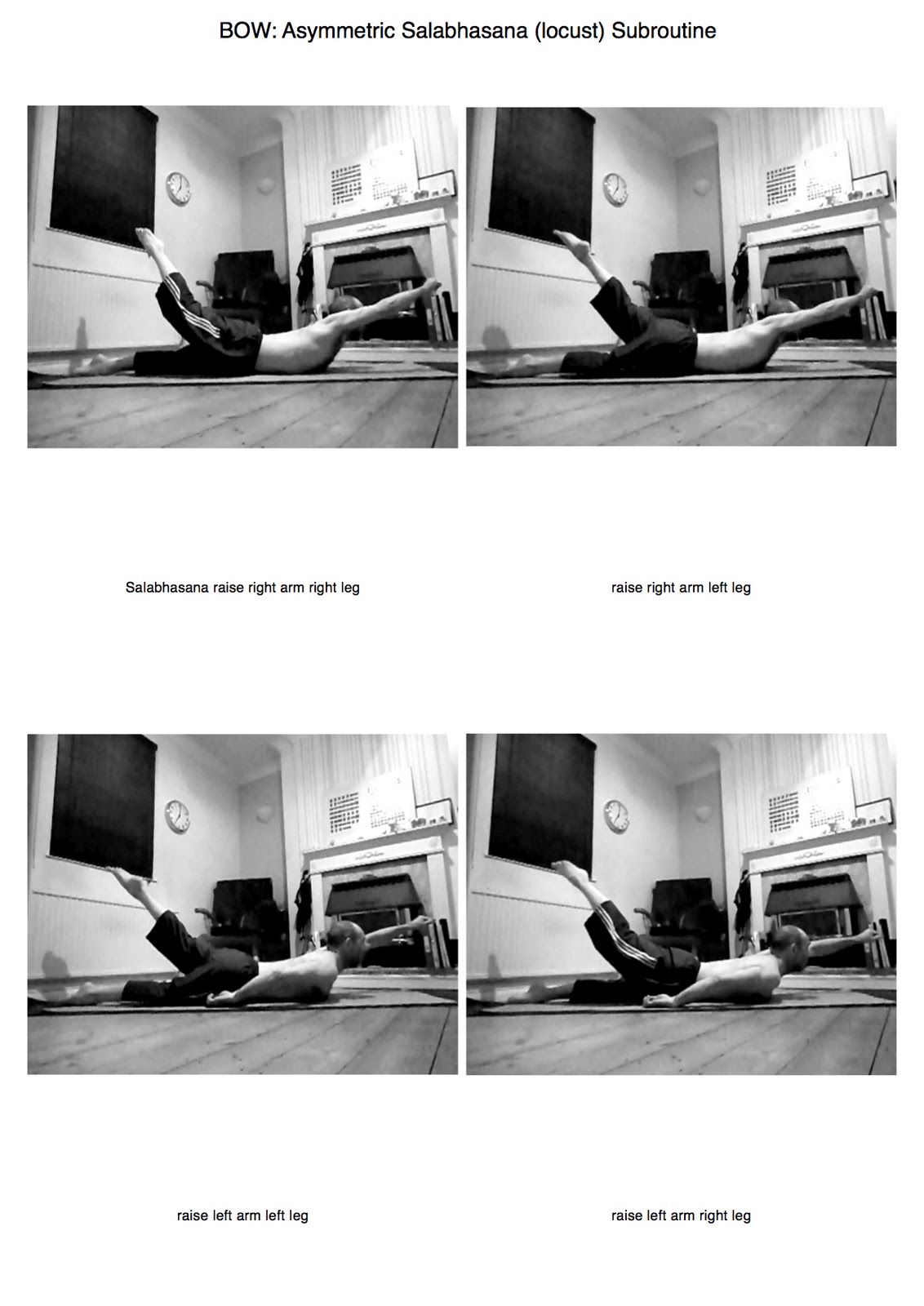
Day 46 : Bow : Asymmetric Salabhasana (locust) subroutine from Vinyasa Krama Bow sequence

VIDEO LINK
HINTS/TIPS/SUGGESTIONS

Ground the leg your are not lifting, push the thigh, shin, foot into the mat

There's a tendency to lift the leg from the foot but activate the buttock and begin to lift from the head of the femur itself rotating it up in the hip socket, along with the thigh, the knee the calf and the foot, lift the whole leg.

Stretch through the length of the leg

At the end of the inhalation give the hip a little nudge upwards while pushing the other hip into the mat.

As with the leg, rather than just lifting the arm stretch right through the arm from the shoulder to the hand.

NB: These are practice notes that will be tidied up and put into the new edition of my Vinyasa Yoga Practice Book along with the current sequences and subroutines. The book can be freely downloaded HERE. There is a page on Facebook HERE with all the latest sheets and updates. This book is in no way a substitute for Ramaswami's Complete Book of Vinyasa Yoga.

Wednesday, 16 November 2011

Day 45 : Bow : Bhujangasana (cobra) subroutine from Vinyasa Krama Bow sequence

VIDEO LINK

Bhujangasana is similar to Urdhva Mukha Svanasana ( Upward facing dog ) except that pelvis remains groundedon the mat.

The postures are repeated again and again in each vinyasa (variation) raising and arching the spine on the inhalation returning on the exhalation.

because they are repeated so many times we can gently, gradually, deepen the stretch as the subroutine progresses.

Raja kapotasana is an advanced back bending posture where we aim to stay for three to six breaths with the head on the soles of the feet.

In Raja kapotasana Ramaswami instructs us to keep the thighs together, this is particularly challenging.

Picture 3 is a gentler version of Raja kapotasana, a working towards it.

HINTS /TIPS/SUGGESTIONS

To work on develop our flexibility we might take a tip from Urdhva Mukha Svanasana ( Upward facing dog )

To go deeper into Urdhva Mukha Svanasana ( Upward facing dog ) where our pelvis is off the mat we are able to arch the back as much as possible but then work from the pelvis and bring it down and almost through the arms which deepens the backbend.

This is possible in bhjangasana also. Arch the back on the inhalation and at the end of the inhalation lift up off the mat enough to bring the pelvis forward a little and back down on to the mat, deeper into the posture.

In arching the back we stretch and lift out of the pelvis just as we have done in the standing bacbending hand/arm variations in tadasana.

There is also a stretch in the opposite direction, try to stretch your legs from your buttocks to your toes, this is especially important in Raja kapotasana.

The main challenge and 'trick' to Raja kapotasana is to keep the pelvis on the mat as much as possible.

To bring the feet closer to the head the stretch from your thighs rather than just the calves.

Raja kapotasana will work the hamstrings and calf muscles and we must be careful not to overstretch them in reaching for the head.

NB: These are practice notes that will be tidied up and put into the new edition of my Vinyasa Yoga Practice Book along with the current sequences and subroutines. The book can be freely downloaded HERE. There is a page on Facebook HERE with all the latest sheets and updates. This book is in no way a substitute for Ramaswami's Complete Book of Vinyasa Yoga.

Tuesday, 15 November 2011

Day 44 : Bow : Makrasana (crocodile) & Manduka (frog) subroutine from Vinyasa Krama Bow sequence

VIDEO LINK
The above video links you to Makarasana This VIDEO LINK takes you to Manduka asana'

I love this gentle lead into the deeper backbends and tend to include it along with pretty much all the Bow sequence when practicing backbends. Much of Bow is similar to the backbend section of Ashtanga Intermediate series but with more vinyasas, more time spent preparing for the deeper backbends.

I often add and/or mix the Bow Subroutine with/to the Meditative subroutines, which includes the Kapotasanas.

Most if not all of these postures and/or subroutines can be used as counterposes for Shoulderstand and/or any deep forward bend although you would tend to start with the lighter vinyasas

These postures tend to be repeated three to six times entering on the inhalation exiting on the exhalation except for manduka asana where you stay in the posture from 3 to six breaths

HINTS/TIPS/SUGGESTIONS
As with all backbends your aiming to stretch the whole length of your spine

Stretch and lift out of your pelvis just as if you were standing

Stretch and push out the chest on the inhalation, stretch the legs on the exhalation bringing them towards your buttocks.

Caution
Manduka ( pic 4 ) can put a lot of stress on the knees make sure the muscles from the pelvis to the ankles are activated, the muscles that cross the knee will give support.

In the beginning use the feet just as support for the hands to push down upon and lift the chest and head, later, in time , when you become more confident of your knees and have built strength in your legs look to push your feet closer to the mat.

As you push down on your feet stretch out through your thighs which will lift the knee and tilt the feet closer to the mat.

NB: These are practice notes that will be tidied up and put into the new edition of my Vinyasa Yoga Practice Book along with the current sequences and subroutines. The book can be freely downloaded HERE. There is a page on Facebook HERE with all the latest sheets and updates. This book is in no way a substitute for Ramaswami's Complete Book of Vinyasa Yoga.