Saturday, 29 September 2012

Srivatsa Ramaswami's talk onYoga and the Three Gunas

Lots of good content on Ramaswami's YouTube channel now, the ten part Vinyasa Krama demo from a while back and now the four 1980's TV slots I posted yesterday and this morning an hour long talk, split over five videos, on Yoga and the Three Gunas.

http://www.youtube.com/user/srivatsaramaswami

"During my LMU visit for the 200hr TT program, I gave a talk on "Yoga and the three Gunas" at the studio of Sarah Mata in LA. The hour long talk in 5 videos are available in my channel. Please have a look. Thank you "Srivatsa Ramaswami

Nothing happens in the first video, just the image you see in the screenshot below


The talk starts here


And this article below on the Three Gunas from one of Ramaswami's first newsletters in January 2009.
His other Newsletters can be found on his webpage here
https://groups.google.com/forum/?hl=en&fromgroups#!forum/vinyasa-krama-announce

Three years of Ramaswami's newsletters have been brought together into three volumes available for free download on my googledocs page

Ramaswami's newsletters Volume I 2009

Ramaswami's newsletters Volume II 2010

Ramaswami's newsletters Volume III 2011


The Three Gunas (Triguna) and the Four Human Goals (Purusharthas) 

According to Yoga and other sibling philosophies, the entire universe
is made of the three Gunas, Satwa, Rajas and Tamas and these permeate
everything (including all of us) everywhere in dominating everything
in varying degrees.  Due to the preponderance of one of these Gunas,
in every individual, different human beings follow different goals.
Even as everyone’s desire is to get happiness and get rid of
unhappiness, each one, depending upon his or her guna temperament,
pursues different means and goals (arthas) for one’s satisfaction or
happiness. The three gunas are satwa, rajas and tamas. The four
purushartas or human goals are dharma (order), artha (material
possession), kama (sensual desires) and moksha (spiritual freedom). A
satwic person is inclined towards dharma, while the rajasic, tamasic
and the one who is able to go beyond the influence of all the gunas
(gunaateeta)  are attracted respectively towards artha, kama and
moksha. These four are called purusharthas or chatur- vidha-
purushartha (four different human endeavors/goals)

Persons whose personality is predominantly satwic, follow ‘dharma’ as
a goal of their lives for happiness. Dharma is the Law of Piety,
Compassion, and orderly life. They follow the benevolent dictates of
the scriptures, the laws of the land, leading a life consistent with
the gods of nature. It is anathema for them to cross the Laws of
Dharma. Such Dharmis are said to lead a very peaceful life here and
hereafter, as they, who are said to be in a small minority, do and
accumulate good karmas.

The Rajasic people are like the proverbial “A” type personalities.
Highly energetic and mostly restless, they pursue very down to earth
policies and follow the goal of artha or material possessions. More
wealth and more power give them happiness and the means are less
important than the goals. Only a few who follow this life long pursuit
of possessions and power ever succeed and sustain, leading to
collective unhappiness of this lot. The happiness of the majority of
them rises with the tide of increasing possessions and ebbs with the
loss of wealth and power.

We have then the third group of people who are dominated by tamas. It
is said Tamas, because it veils the intellect, makes such people short
sighted. Their happiness lies in sensual gratification. Tasty food,
frequent tactile stimulus, attractive visual objects and captivating
sounds dominate their life. When the senses over a period of time lose
their acuity, they have less room to be happy and fall into a state of
depression as they get older.

Then there are the spiritual Yogis who relentlessly follow the path of
spiritual wisdom and intuitively understand the nature of the ever
present, non changing nature of their own Self and reach a state of
Kaivalya or Moksha or spiritual Freedom. In that state, according to
Yogis, the three Gunas reach a state of equilibrium. This, the yogis
call a state of Nirodha of the mind, or a state the Lord in the Gita
calls Gunateeta or beyond the dominance of the Gunas. This state leads
to a permanent and irrevocable state of peace of mind and the yogis
aver that it is superior to the other variable and unstable states of
happiness; superior to that attained by sensual gratification of the
tamasic personality or the happiness arising out of possessions of the
Rajasic, or even the dharmic life of a Satwic person. Though the
satwic state of happiness is superior to the other two, even that is
said to be impermanent. Hence the Lord urges everyone, through His
disciple Arjuna in the Gita, to go from Tamas to Rajas and then to
Satwa and ultimately transcend all the Gunas. It is easier said then
done.

But how is it done? Only Yoga comes with specific measures to change
the individual personalities. One can transform a Tamasic mind to a
Rajasic bent by practice of Pranayama, in addition to the observance
Yamaniyamas. The observance of a well designed practice of asanas will
reduce the addictive influence of Rajas and hence a yogi who practices
asana and pranayama will become more and more Satwic, thanks  the
reduction of Tamas and Rajas. And by spiritual meditation one will be
able to transcend all the three Gunas.

So as Lord Krishna says, “Tatha yogi bhava Arjuna”, (Therefore become
a Yogi). One should practice Yoga. You will agree?

Srivasta Ramaswami

Friday, 28 September 2012

Srivatsa Ramaswami VinyasaKrama Yoga TV Slot (1980) also details of Ramaswami's UK trip next month

Wonderful surprise this morning to come across this old Video of a TV slot Ramaswami presented back in the 1980's. The caption says it's the first of a series, so hoping for more of these.

UPDATE" Ramaswami has just added three more, all included below

So nice to hear my teachers calm gentle voice again, guiding you through the movements with a minimum of fuss.

If your style is Ashtanga you might like to look at these as an option for a short evening practice, perhaps pre pranayama or meditation. Something for Saturdays or moon days perhaps or if you have an injury.  Vinyasa Krama is also excellent for exploring the postures and variations around the asana we do daily in Ashtanga which could help as preparation, teaching aids etc. Richard Freeman on the recent workshop I attended employed several variations of our regular asana that reminded me of Vinyasa Krama.

Looks look Ramaswami is doing a voiceover here, no doubt because of the poor quality of the video recording, no doubt he will mention these videos in his October Newsletter and tell us more about them.

The video starts of with some standing tadasana variations followed by twisting and forward bending, paschassana is five minutes in. Next up are some triangle postures (looks like a different video). Another video change ten minutes in and the sweetest little jump through, knees bent but without the ankles crossed. They then move into some seated postures followed by another video change and a virasana/vajrasana sequence including backbends and a very nice kapo after fifteen minutes.

Of course in your own practice of this sequence you can take it even slowly, lengthening the breath further, stay for longer in the postures as Ramaswami indicates and perhaps do more repeats etc.

Looking forward to downloading these and practicing along this evening.

A series of TV programs of Srivatsa Ramaswami on Vinyasa Krama Yoga in 1980

"During the early 1980s I gave a(n)  8 part series of asanas following
the vinyasakrama with my students from Kalakshetra. Each program was
about 20 mts aired every week under the youth program. Part of it was
asanas and the other part an interview with me which I have deleted in
these videos as they were in Tamil.. My son Badri, 8 or 9 at that time
had recorded it. During my visit to Chennai in Feb, my friends
Srimathy and Ravi of Ashtanga Yoga Chennai and former teachers at KYM
helped to edit it and get portions of the audio replaced with my
Indglish descriptions. The video quality is poor and the audio blank
in the later parts. It was interesting even for me to see how I was
teaching 30 years back. Have a look (at all the 4 videos) if you have
the time and maybe you would like to forward it to a friend or two.
Here are the links
Vinyasa Krama asanas 1980 I      http://youtu.be/vEM_QbH2fdo
VinyasaKrama asanas 1980 II  http://www.youtube.com/watch?v=iKbmT8Ssuho&feature=plcp
VinyasaKrama asanas 1980  III http://www.youtube.com/watch?v=tjMrVq6HuOw&feature=plcp
VinyasaKrama asanas 1980  IV http://youtu.be/olAhZEBWTr0
For a more complete treatment of Vinyasakrama asanas, maybe you would
like to look at my book “The Complete Book of Vinyasa Yoga”. Here is
the Amazon link
Find this book on amazon.com"
Srivatsa Ramaswami Oct 2012 Newsletter

I Standing, triangle and some of the meditative series built on virasana and vajrasana


II Supine postures inc. Shoulderstand and some lotus postures


III mostly Bow postures


IV Some Seated and Asymmetric postures

 
Ramaswami is coming to The UK early next month, here's a link to the Harmony yoga website and to the appropriate page, has to be said that i find the web page for this really confusing and you may feel the need to email or call to actually check if there are still places.

Here's the link
http://www.harmonyyoga.co.uk/srivatsa-ramaswami-2012-uk-workshop-details/

And below all the details from Steve's harmony Yoga website.


Srivatsa Ramaswami 2012 UK Visit

October 5th-14th, 2012

Update: 
Just heard the course is full except for the Wednesday 10th Mantra yoga in the afternoon.
Which is a shame as I suddenly had the opportunity to attend the first day.

Programme summary

October 5th: The Essentials of Vinyasa Krama Yoga.  (1day. 6 hours.)
October 6th-9th: The Yoga of Sri T. Krishnamacharya (4 days. 24 hours.)
October 10th: Mantra Yoga. (Afternoon. 3 hours.)
October 10th: Vinyasa Krama Yoga Practice. (Evening. 1h 45 mins.)
October 11th-14th: Hatha and Raja Yoga Practicum. (4 days. 24 hours.)
All workshops will be held at: Wells Museum Conference Room, 8 Cathedral Green, Wells, Somerset, BA5 2UE, UK
The venue is located on the historic Cathedral Green in the medieval city of Wells. The Conference Room is a pleasant, spacious room overlooking a walled garden.
Scroll down for workshop details, course fees and booking procedure.

Workshop Details

Friday  5th

The Essentials of Vinyasa Krama Yoga

1 day (6 hours): 9.30am-12.30pm &  2.30pm-5.30pm
Vinyasa Krama is an art form of practising yogasanas, based on the parameters mentioned in the Yoga Sutras. Sri Krishnamacharya taught this method of asana practice in which several asana movements or vinyasas are practised in succession slowly and with synchronisation of breath. In this program, you will experience an introduction to Vinyasa Krama, pranayama and the basics of meditation based on the Yoga Sutras. There will be a Q&A session as well.
All levels of experience are welcome.
Recommended reading: Ramaswami, The Complete Book of Vinyasa Yoga.
Saturday 6th – Tuesday 9th

The Yoga of Sri T. Krishnamacharya

4 days (24 hours): 9.30am-12.30pm & 2.30pm-5.30pm each day.   24 hours
Sri.T. Krishnamacharya taught not only yoga and the various aspects of yoga, but also several other related orthodox philosophies. He was a qualified teacher of nyaya, the powerful system of logic used for spiritual discussions in olden times. He was known as Nyayacharya. He taught Nyaya Sutras and Tarka Samgraha, two important ancient works related to this subject. He taught Vedic chanting extensively and was given a title Veda Kesaari (Lion of the Vedas). He not only chanted with a booming voice but also taught the Vedic philosophy related to the ritualistic portion, known as Mimamsa. He taught Samkhya as well, and obtained a diploma in this philosophy, for these achievements he was known by the title Samkhya Siromani (crest jewel of Samkhya).
Of course he was also known as Yogacharya. His unique Yoga teachings of Vinyasa Krama, therapeutic approach and the Yoga philosophy, made him an outstanding  Yoga Acharya. He taught the Upanishads, the Bhagavad Gita and the Brahma Sutras, the important three sets of texts for the Vedic philosophy known as Vedanta and earned the title Vedanta Vageesa, meaning the “master exponent of Vedanta.” He could teach with equal facility the Advaitic and Visishtadvaitic interpretation of Vedanta, even though he favoured Ramanuja’s Visishtadwaitic interpretation. Apart from these Vedic subjects and philosophies, he also was a scholar of the great epic Ramayana (story of Rama) and other religious/mythological works such as Vishnu Purana, Bhagavata Purana (Story of Lord Krishna), as well as several other Vaishnavite religious texts.
He taught these subjects individually, depending upon the requirements of each student. Because of his vast studies and knowledge, he had a very comprehensive view of the whole range of Eastern philosophies and religious practices and guided his students according to what he thought was the appropriate path for each. Yogis who would like to enlarge their knowledge base of spirituality may wish to study more of these texts, slowly, one by one.
In this program an investigation  into his teachings will be made based on the studies of Srivatsa Ramaswami under Sri Krishnamacharya over decades.
Suitable for Yoga Teachers and experienced practitioners.
Recommended reading: Ramaswami, The Complete Book of Vinyasa Yoga, Yoga for the Three Stages of Life; Ramaswami and Hurwitz, Yoga Beneath the Surface.

Wednesday 10th  – Mantra Yoga

Afternoon (3 hours):  2.30pm-5.30pm
For every Raja Yogi there are 100 Hata Yogis and for every Hata Yogi there may be several hundred mantra yogis. Mantra yoga and Bhakti yoga form an important yoga that is easily accessible to millions. This programme will include a general discussion about mantras and the chanting of important mantras like Pranava, Gayatri and others like Sanskrit alphabet mantras (matrukas) will also be taught.
All levels of experience are welcome.
Wednesday 10th – Vinyasa Krama Yoga Practice
Evening Session (1 hour 45 minutes): 7pm-8.45pm.
Vinyasa Krama is an art form of practicing yogasanas, based on the parameters mentioned in the Yogasutras. Sri Krishnamacharya taught this method of asana practice in which several asana movements, or vinyasas, are practiced in succession slowly and with synchronization of breath. In this program you will experience an introduction to vinyasakrama, pranayama and the basics of meditation based on the Yogasutras. 1.5 hours practice and 15 minutes Q&A session.
All levels of experience are welcome.

Thursday 11th – Sunday 14th

Hatha and Raja Yoga Practicum

4 days (24 hours): 9.30am-12.30pm & 2.30pm-5.30pm each day
Asana practice has caught the imagination of a number of enthusiasts—especially Vinyasa Krama, the sequencing art form of yoga practice. However, yoga has other important ingredients, all of which promote a positive transformation of the individual. A holistic approach would require the yogi to practice not only asana and pranayama (the Hatha yoga aspects) but also chanting, meditation, and contemplation of the philosophical and spiritual aspects (Raja yoga).
In this program, half of each session will be devoted to different asanas, following the Vinyasa Krama method. It will involve doing more than 300 vinyasas, or variations in classical yoga poses, in the course of the program. The other half of the time will be utilized for detailed and varied yogic breathing exercises and the other Raja yoga practices, like chanting, meditation, and philosophical and spiritual contemplation of the yoga sutras. The objective by the end of the program is for participants to have a well-rounded understanding and practice of yoga, as opposed to doing only asanas or meditation. Hatha yoga and Raja yoga are aspects of the integrated system of yogic progression.
Suitable for Yoga Teachers and experienced practitioners.
Recommended reading: Ramaswami, The Complete Book of Vinyasa Yoga, Yoga for the Three Stages of Life; Ramaswami and Hurwitz, Yoga Beneath the Surface.

Thursday, 27 September 2012

Krishnamacharya on Headstand and Shoulder stand from Salutations to the teacher and the Eternal one

Krishnamacharya Yoga Makaranda 1934

" In Shirshasana, normally no kumbakam (breath retention) need be done, though two seconds UNTHER (after inhalation) and BAHYA (after exhalation) kumbakam automatically result when we change from deep inhalation to deep exhalation and vice versa. During the automatic pause kumbhakam takes place. When after practice has advanced and kumbhakam is deliberately practiced, Unther kumbakam can be done up to 5 seconds during each round and Bhya kumbakam up to 10 seconds" 
Krishnamacharya. Salutations to the Teacher and the Eternal one p17. (My explanations in brackets)
------------------------
Here's Krishnamacharya introducing the headstand and it's approach as well as exploring it's variations and it's relation to the shoulderstand. Particularly interesting to look at his use of breath in these postures.

But first my Introduction to the text from first post in this series....

I was passed this document recently called Salutations to the Teacher and the Eternal One purportedly by T. Krishnamacharya. I received it from two sources. one asked me to only share it with somebody who asked directly and I've respected that. I've since received the text from another source with no conditions attached and so have decided to share it.

Peter Sterios mentions the text in a Yoga Journal article, For beginners, Balasana

In "Salutation to the Teacher and the Eternal One," a paper written by T. Krishnamacharya and distributed to students at the Yoga Mandiram in Madras, he says: "One important thing to be constantly kept in mind when doing asanas is the regulation of the breath. It should be slow, thin, long, and steady: breathing through both nostrils with a rubbing sensation at the throat and through the esophagus, inhaling when coming to the straight posture, and exhaling when bending the body." 

and Shandor Remete mentions it in his book Shadow Yoga

“… During this time, I also had the good fortune to receive some of the early writings of Sri T. Krishnamarcharya of Madras. Among these, one short work has influenced me profoundly: Salutation to the Teacher and the Eternal One. It has been this book more than any other that has helped me to decipher and understand the ancient hatha yogic texts in their fullness…”

However, since receiving the text I haven't been able to confirm to what extent, if at all, it was written by Krishnamacharya. At times there seems to be a mixture of styles, was it perhaps a series of notes by Krishnamacharya for a book project that never materialised and ended up being passed around among students of KYM, who in turn added notes to the text. Or perhaps it was lecture notes written by Krishnamacharya for a course at KYM presented by someone else who then responded to questions from students.

Either way it's a fascinating document.

Enjoy

Here are a couple of sample pages, the full 41 page text can be downloaded from my Googledocs page.

https://docs.google.com/open?id=0B7JXC_g3qGlWemJSRVhtLXFlSVU

Yogasanagalu 1970's edition


Tuesday, 25 September 2012

Krishnamacharya 'stopping' ( or at least slowing) his heart, medical journal article Presse Medicale-1936

REPOSTED WITH A TRANSLATION BY MATTHIEU BONETTI OF THE ORIGINAL 1936 PRESSE MEDICALE ARTICLE

The article is heavy going in places but if your short of time jump to the results section, skimming through get a feel for the experiments that took place and allow free reign to your imagination.

A huge thank you to Matthieu for sticking with a difficult document to translate

This post, including the original article and it's translation as downloadable as a pdf.
https://docs.google.com/open?id=0B7JXC_g3qGlWazFfdjdjLXM2YUk
--------
"On many occasions he demonstrated the great potentials of yoga in different areas of health and self-control over oneself. The most prominent among them was being able to stop the heart beat for more than two minutes, using yogic practices". from Śrī T Krishnamacharya – The Source

--------------------------

"Having visited there (Mysore) before, I once witnessed a demonstration given by the pupils followed by an extraordinary feat by Shri Krishnamachacharya, the teacher. He lay on the floor and then proceeded to stop his heart beat for several minutes much to the astonishment of several physicians who had come with their stop watches and stethoscopes.
I would have pronounced him dead", said a German doctor after the examination." 
Indra Devi : Yoga the technique of Health and Happiness ( pub.1967)
Thanks again Ryan

------------------------------------
"Far from being secretive about it , Krishnamacharya performed this feat (stopping his heartbeat and his breath) on many occasions, often in front of audiences of several hundreds to more than a thousand, as part of his demonstrations of the possibilities of Yoga. In fact his moment of greatests international fame came when a group of European medical experts carefully monitored my father as he stopped his heartbeat, pulse, respiration and other electro-chemical functions associated with life, then after a few minutes, gradually resuming them. The medical team's report was duly sensationalised in European and American newspapers of the day. In India this seeming power over life and death attached to my father's legend - somewhat more, I suspect, than he might have wished.
     I had heard about my father's control over his heartbeat all my life. As a science student, I was frankly skeptical. I would ask him, "Father, is this really possible?" One day in 1965, after I already had been studying with him for a few years, he closed his eyes and told me to feel his pulse, I did, and it began to fade until it disappeared. There was no pulse at wrist or neck, and absolutely no breath. This went on for at least a couple of minutes, and then started up again.
"Father" , I said, " I want to learn this".
"I will never teach it to you", he said.
"Father," I argued, " I need to show others."
"No!" he said, very forcefully. "This is not useful to society. This is only an achievement....," and here he used a term that might be translated from sanskrit as " ego trip".
"I had to do this to convince the public about the power of Yoga. Now it is done. You don't have to learn this. you must only learn what is useful to the public, to society."
I tried arguing more . I was vary curious. I would have done anything for this experience: What would it be like to bring "life" to a halt, even for a minute or two" But he wouldn't budge. He always felt that whatever we receive must be shared. the worst thing was not to share, but this particular power was not to be shared."

------------------------------------------

Below is the medical journal article from Presse Medicale-1936 relating the experiment to observe Krishnamacharya stopping/slowing his heart and breath.

The article was passed on to me by Satya (it should be out of copywrite now as it's before 1964), Thank you yet again Satya.

Translation by MATTHIEU BONETTI  below the original


TRANSLATION


Original works


Documents retrieved in India on the "yogis"

by

Simultaneous recordings of the pulse, breath of the electrocardiogram
by
Mr Charles LAUBRY and miss Thérèse BROSSE

In a previous article, we have objectified using a sphygmograph to study the influence of mind concentration over circulatory phenomenons. First we have shown that certain normal subjects could at will and instantly accelerate or reduce their heart beat. On the other hand, on subjects presenting a purely functional arrhythmia, we have seen in a good way and under influence of a constant attention, the modification of disorders and disturbances that was the consequence of a long series of diverse emotional states.

Those experiments brought new proof to the more and more admitted and established interdependence between purely physiologic functions and psychic personality. Certainly the psychoanalytic works reveal the possibility of a supremacy of the inconscient toward the consciousness. But this abnormal and pathological reaction could not constitute an acceptable vision of the normal human being. Since despite the duality of the nervous system, the vegetative life cannot completely evade from consciousness, it was important to know the scope and the modality of their reciprocal relations. Our experiments had allowed us a glimpse of this and at the same time had showed us its scope. Those interactions are harmful when there is an emotive diffusion and that the vegetal life overwhelms the personality. They are regulated when consciousness takes over and become the master. Therefore we oversee among the neurotonic, the possibility of a re-education where that retrieving or regaining of the mastery of consciousness, decrease the functional perturbations.

It was difficult in the western world to obtain solid bases about this psychotherapy, on this preventive mental hygiene. There isn't among us enough subjects or specially trained subjects to record sensational results. Recently Abrami and his students have published a curious observation on voluntary self hypertension. But this is an exceptional case, at least in our countries. It is difficult to situate it in the context of a general study about the mastery of the vegetative functions. There is none in our schools that systemize such habits. No one is teaching s
uch an education. It appears to us that, what was impossible or at least really difficult in the western world, could happen in the eastern world, in India, where there are secular schools called yoga that strive to train their subjects to unusual and unknown to us physiologic control. That's why one of us took a long study journey to the English India, with a specific program based on our previous studies, in order to confirm and if needed to get more data.

There wasn't any system more interesting for us to know and explore than this "yoga". Founded exactly on the hierarchy the physiologic and psychologic levels, it has for it's goal complete mastery. On this scale, the yogi raises progressively and voluntary his consciousness. With an heavy effort of concentration and particular with physical exercises, he adapts himself to each mechanism and governs it. He manages this way, little by little, to identify his consciousness at the upper level. The goal of this elevation is to achieve the union with the universal (yoga means union). The discipline the yogi imposes on himself is therefore of a religious inspiration. But though mystical, it is none the less a careful and persevering education of the physical health which is a mandatory basis and training to the voluntary mastery of the purely vegetative functions. It was mainly important to observe in what manner the cardiovascular undergo this influence.

*
*  *

There are many categories of yogis in India. Some are are frauds, very numerous, that exploit at their will and in a various way the respect that the whole people are bringing to yoga, a science of spiritual asceticism and holiness. Fakirs are not yogis. Some experiences with those hustlers have shown to be costly and scientifically null.

The true yogis are however not mysterious or exceptional beings. The religious writings from where they derive their mystics are, are in India known by everybody. But they are rare. They live retired from the rest of the world, sometimes completely alone, sometimes surrounded with students. Some however find their retreat in the heart of cities among the uproar of big agglomerations; they stay as inaccessible as the yogis in the jungle, protected by the hermetism of their language, and by the difficulty to approach them in an intellectual or religious way. We were able to overcome those obstacles by bringing to the yogi sympathy for our work by explaining him frankly our desires and the aim of our researches and provoke in this way an active collaboration. By understanding the power of our tools and the value of their data, they contributed despite the inherent problems associated with our experiments with a great calmness and with an absolute trust, oftentimes with a touching gratitude for the interest we were witnessing to their effort.

Yogis we have studied can be classified into three categories:


  1. The professional hatha yogis: trained to master their organism. They use the yoga exercises for therapeutic reasons or simply for hygiene. They are fitness teacher in special schools. One of them is managed by the Maharajah of Mysore. They live an ordinary life. They are married and have a family. With them, we had the most significant results. Their medical gymnastic system based on the hatha yoga seemed to us to deserve the highest point of interest for the westerners.
  2. The non professional yogis: They practice yoga as the most beautiful system of health, an art closely applied to their religious life, but that obtains them a perfect balance between the physical and moral. The food restrictions that dictates yoga seem to them to be neither asceticism nor superstition, but the application of a intelligent pratique wisely followed. One of them, sergeant in the guard of the Maharajah of Baroda, has an athletes body. He masters it at the point to isolate at will a group, a muscle or a part of a muscle without circumvent to the other exercises we will come to.
  3. The Raja Yogis: They follow the psychic and mental yoga (the royal yoga). For them, the hatha yoga and the physical exercises are only a training to the mental discipline. They use it to destroy the shackles to the interior ascent rather than an ownership on the body, that itself doesn't interest them. They however participated to our explorations with extreme good will.

Before restricting ourself to manifestations of the circulation levels, the purpose of our preoccupations, it is not useless to report some unusual and voluntary physiological prowess that we could have witnessed, that are unusual or exceptional to the western world, and that we can properly consider to be amazing. The mastery of the yogi on his muscular system results in strange attitudes or curious consequences. For example, it lets him perform lateral movements of the right large abdomen muscles in order to make a limited, accurate, and efficient massage. The absolute authority and natural affinity that he owns on his voluntary muscles, the yogi acquires it as well on the large smooth fibers. He regulates this way, at will, the peristaltic and anti-peristaltics movements. He ensures the clearance between all his sphincters, anal or bladder and by suction and by aspiration. He makes by himself  and without instrument water to penetrate in his digestive tube. He practices a bladder injection or a washing of the intestine.

TECHNICAL

As in our previous studies we haven't neglected the mechanical processes: a seismograph associated with a pneumograph: completed with cardiography with the help of "Marey's button".

Moreover, we have used an electrocardiogram a means of more penetrating investigation .


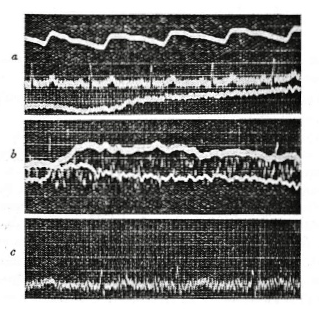
Fig 1. Inscription of the plots on the muscular tension during the exercises (derivation 1). a) Slight interference with the electrocardiogram and the ripple of the pneumographic curve. b) A tension more profound makes the electrocardiogram and the pulse unreadable. c) Comparable aspect of a westerner during the tensioning of the *thoraco-abdominal* muscle on a forced exhalation.

We have used the portable cord electrocardiograph from Boulitte in its little model, using his photosensitive device, to have on the same pelicula both arterial and respiratory curves, obtained with the help of the Pachon-Boulitte capsule and the Marey's pneumograph. We also had simultaneous curves that let us study not only the different modifications of each functions but their reciprocity.

Our recordings were done during yoga practices that included a maximal immobility.

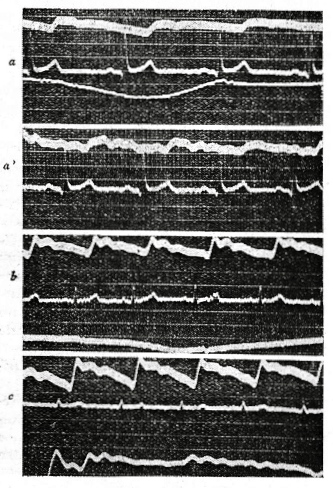
Fig. 4. a and a') emphasis on the arterial waves under the influence of the mental concentration (before and after). b) and c) On another subject, clearness also of the detail of the pulsatile wave. On another part, low voltage during exercise c) coincides with the raise of the height of the arterial pulsation.

It had for it's basis: on one part breathing exercises, with long apnea, some during inhalation, some during exhalation. on another part with mental concentration efforts. sometimes it was usual exercises and progressive of the yogi, sometimes special exercises that seemed to us that could influence more particularly the circulation. All those reviews usually need a black room and an appropriate installation, both for the recording than for the immediate development of the pelicula.


Fig. 2. Modifications of the waves P and T of the electrocardiogram during the same exercise (derivation 11). a) Flattening of P with a low voltage, at first. b) a minute after, accentuation of P and flattening of T and raising of the voltage for the rapid waves. c) At the end of the exercises, during the "control of the heart", regular aspect of the electrocardiogram.

In the present case, we had to deal with poor conditions, often made outside in a coverage of clusters and those difficulties will excuse the heterogeneous taints and impurity of our plots.

We have gathered during two months 300 meters of electrocardiograph films and performed over 41 different examinations. Each examination matches a yoga exercise, of a duration of 15 minutes, during a progress of 10 seconds by 10 seconds. This technique was sufficient to follow, as close as the mandatory photosensitive paper allows, the progressive progress of the different phases of the psycho-physiological work.

We have attached to the previous graphical methods the study of the fundamental metabolism, as much as the portative Morisse's device let us its evaluation. Finally we apologize that we couldn't measure the arterial tension.  But we have recorded with the use of usual devices, either the Pachon's oscillometer, or the Vaquez-Laubry's sphygmomanometer.

THE RESULTS

It was difficult to enter in detail the plots we have gathered. The reproduction of a sufficient number of fragments is however enough to give us the idea of the most frequent modifications. Indeed, broadly, the same aspects happen again from one subject to another. There are between them only differences of degrees. Thus, despite the difficulties of the distance, our graphics witness the relatively perfect unity of our technique.

From all our graphics, 3 elements seem to show up in a way almost constant. They are:


Caption. 3. a) and b) During this exercise during which the electrocardiogram (derivation 1) witness the few of the muscular tension, note on one hand the rapid wave reduction of B and the elevation of S, on the other hand the exaggeration of the shock of the tip on the pneumograph line that stays horizontal in apnea (kumbhaka, breath holding). In b, the exaggeration coincides with a significant reduction of the pulsatile arterial wave.

1# The voluntary modifications of the rhythm and of the intensity of the breathing. Important to the yogi in a symbolic point of view, and as an important step in the progression of the studies in the practice of yoga, there are nonetheless interesting to the physiologist, to ease the understanding of measured cardiovascular perturbations. The complete apnea phasis ( breath holding phase- kumbhaka) are done, sometimes with the lunges full, sometimes with the lunges empty. They follow each times an inhalation abnormally long and deep. One are absolute (cap 3 a, b and 5 d) and can last easily to 5 minutes. The others let place to a superficial breathing (cap 5 b), of a duration even longer, and which varies from 15 minutes to many hours.


Caption 5. a) At the begining of the exercise, normal electrocardiogram (derivation 1), breathing extremely superficial). b) Some seconds later: increasing of all electrocardiogram waves and of the pulse picture. c) 2 minutes later: low voltage on all wabes. d) around the 10th minute of the examination: more significant decreasing  of the voltage under total apnea. At the end of the exercise, the picture was the same as in a.

2# Muscular tensioning. Not only it lasts with the forced inhalation and exhalation efforts, but it lasts the first part of the apnea period, and follows the intimate contraction of the diaphragm and the other muscles. whereas the macroscopic and the muscular curve ended. Before the releasing period, that only let the reading of the electrocardiogram, we have often recorded, during the exercises, the oscillation of potential differences due to a muscular tension, that interfere with the electro, or a substitute depending on its intensity (cap 1 a,b). It is easy to obtain the same pictures on our western subjects. We just need them to do this muscular tension in apnea during an electric recording. However the aspects are smaller than during the yoga exercise (cap 1 c). In the curious test of voluntary hypertension published by Abrami and his students, we note the same, and the author rightly insists on this special phenomenon of muscular tension. Note that the biggest electrocardiographic manifestation were obtained during the releasing periods, either in apnea, either under insignificant breathing, that follows those long inhalations or exhalation with muscular tension. Although this releasing were not absolute and the plotting offer again and slightly crenellated aspect (cap 3).

3# Phenomenon of mental concentration. It is the last element associated with the previous two during the yoga exercises ; according to our subjects, that have often and long said, it is the most important.


It is unfortunate that we couldn't have controlled it with the help of a cathodic oscillograph or with an encephalograph and to have a new curve according to the one we have obtained. The bad condition we were exposed prevented it, and although we had only one try, a sort of an approach exploration regarding strange customs. Failing to have objective documents, we could gather, as well from the literature that treat the question, than from the yogis themselves some characteristics of their mental state. They have nothing in common with the passive states like "trances" of a medium or a fakir. They are opposed. It is a systematic and organised meditation on a various object. The projection to an organ or a part of the body for the hatha yogi, a philosophical concept for the raja yogi. Whatever it is, his technique is immutable and can be split carefully in three steps:


The first is a powerful concentration effort that only brings thought on the object without possible failure.


The second is a happy and easy contemplation of the object of focus; at this level it remains a duality between the subject and the object.


At last in a third time, the duality is removed. There is an identification of the self and the object.

If we relate to our rudimentary focusing experiments that we used during our first researches, we start to think that this conscious effort is no stranger to certain cardiovascular modifications, but the yogis performs this complex phenomenon and we can't think of each of those steps separately. It is those three steps that determines the modifications that we report and bear:
a) The heartbeat ; speeding up is the rule, almost constant. It can easily reach 130 to 150, whereas the "bradycardia" phasis don't exceed 55. The heartbeat frequently varies during the same apnea phasis, without the possibility to individualise an arrhythmia of type sinus. The sporadic extrasystoles are exceptional.


Fig 6. a, b, c 

Yogi student in the school of the palace of Mysore
a. in one of his "posture".
Teacher of a yoga school:
b. at rest.

c. in one of his posture


b) On the amplitude of the pulse. The pulse not only offers modification of the rhythm, it shows by the height of its wave, in the report of the different waves together, in their emphasis, in their aspect, this means in the amount, in its degree of diastolic wave (capt 4 b and c) significant changes. Those changes were even more strong that the recording was practiced at the moment that the mental focus, according to the subject, were at its peak (cap 4 a'). All the plotting of the pulse were recorded at the minimum level, to avoid a compression too painful and fatigue of the artery.

c) On the changes of the cardiac shock.  Changes to the inclusion of precordial shock during apnea on the pneumo graphical trace have given us, if not given real point plotted, at least revealed variable intensities in the shock, whether it is hypotonicity or myocardial hypertension, or displacement of the heart relative to the wall (cap 3). By comparing these graphic data with the auscultation, they seemed to coincide with the moment of complete silence and an imperceptible pulse at the radial, but fall slightly to the humeral. Only the electrocardiogram stayed normal, except a low voltage. We regret not having verified the sensory data by phonocardiographic recording.

d) On the electrocardiogram modifications. Because of the fixation of the device for a given individual, those results are to us the most curious. The modifications are never on the inter-cardiac conduction. They affect the different waves, either in their existence, either in their high, either in the report of their reciprocal high, and this to a few seconds or minutes of interval on the same trace. On several occasions we have noted the millivolt to avoid in our reflexion rough mistakes. And follow one another on the different curves:


1# Lack of P with complex QRS and normal T (cap 2, a).
2# During the ordeal, the flattening of T with the appearance of P (cap 2, b).
3# At the moment of the yogi announces the control of his heart, normal aspect of the 3 groups of waves (cap 2, c).

In other cases, there is a phase out of R, and an accentuation of S (cap 3): those recorded results on a same derivation that makes them comparable.


More often, it is a general low voltage (cap 4 and 5 c, d). In this order of facts, the more extreme case consists in a low voltage so emphasized that, along with a 'crochetage' and an enlargement of the ventricular complex, it ends up by a flattening and a complete disappearance of the waves. We can only see, on the iso-electric line, a tiny fibrillation, only remnant of the cardiac contraction. However, this electro, so abnormal, was at first perfectly normal, and was back at the normal state at the end of the experiment, with waves rather exaggerated during the heart control by the yogi. Believing him, he would have attempted to remove the "prana" from his heart, to him a vital fluid (cap 5). This return to normal isn't an exception, because it was like that in each experiments. At the beginning and at the end, the normal aspect of the electro framed the modifications, so thin or so large they were, without us noticing any trace of pain in the heart.

e) On the report of the different curves.  This comparison offers some interest and variable results.  Sometimes we noted increasing of the sock of the tip with a drop down of the voltage and a lowering of the high of the pulsatile wave (cap 3 b). Sometimes on the contrary, we noted the increasing of this one and at the same time a low voltage (cap 4c).

f) On the arterial tension. Recorded before and after the exercise, it has ever showed normal: 14-7 ; 16-8; depending on the subject. During the exercise, when it was possible to note some numbers, it showed invariable. Our study in the view lacks of neatness, because it was difficult, for a sole experimenter to make a continuous triple recording, and a systemic study.

g) On the basal metabolism. While it is possible to judge it by the neutralization of an alkaline solution by exhaled carbon acid, Morisse device, it seemed to us lowered, always during the experiment and the yoga exercises. This neutralization needed a notably longer time of 1 to 2 minutes. It was natural that it should be this way and that we obtained the witness of a slowdown of all function of the organism.

*
*  *

Those objective data are curious. But they are hard to interpret. The electrical pictures that we have gathered show obviously disturbances in the myocardium. But of what kind and what is its seat? Sometimes if we consider the modifications of the ear disturbances and the variations of the slow wave T of the ventricular complex (cap 2), there is an analogy coming to the mind with the distortion provoked by the "digitaline". Sometimes the aspects of the "low voltage" are those of severe degeneration almost terminal of the myocardial fiber. It is hard to not emphasize the coincidence of those distortions with the periods of apnea, the coming back to a perfect integrity when the breathing have found back its size. Also isn’t it unlikely to think that the respiratory amplitude abnormally leads a concentration of carbonic acids in the blood, and that way the myocardium undergoes the influence of this relative asphyxia, that cease when oxygenation becomes normal again. However we know that the parallelism between the failure of pulmonary ventilation and the decrease of the breathing movements is far from being the rule. There is at the contrary antagonism. This one is at all even more perfect that the breathing movements are less frequent and wider, due to an extended osmotic contact and the decrease of the harmful space. The lack of faintness among our yogis let us suppose that it is the case, unless they are trained to support without discomfort physical conditions that are precarious to others.
Another hypothesis that also comes to the mind, and that doesn't invalidate the variable outcrop of the tip of the heart: the dilatation and the extreme decrease of the volume of the chest could bring changes in the axis of the heart and would play their role in the variations and the potential differences.

Who knows if, in the mechanisms of the electrocardiogram, we wouldn't have the proof that those modifications of the superficial tension at the level of the contractile tissue would provoke a distortion of the trace without the muscular mass in its whole had been modified.
All those hypothesis could be
infinitely multiplied . Each one would deserve a dedicated study to verify if well-founded. But each time they are posed, the necessity is felt to do more complete examinations and more numerous. It would be necessary, among others, to have more appropriate devices to translate into a western physiological language those exercises and those empirical appearance state. Those require from their adepts a rigorous technique, logical, that has always identical laws, and maybe a deep examination would reveal much more scientifically that would let suppose the traditional presentation. It would be the case with suitable devices to record curves that would give a picture of the cerebral activity especially in play by the yogi.

Because of various and uncertain solutions that are arising from the reading of the plots, and an investigation willingness better armed, are other considerations born from all the observed phenomenon.

They are first on the safety action techniques inspired by empiricism alone, and at the service of an inflexible faith. We couldn't deny the importance of the physiological results obtained besides the rudimentary or erroneous anatomic notions. If the yogis ignore the nature of their organs, they are the indisputable master of their functions. They enjoy of a magnificent health and however they have inflicted themselves through years of exercises, they could not have supported if they hadn't respected physiological activity laws.
From this rigorous discipline, that ends in an 
almost complete mastery of the vegetative life, that we couldn't either enumerate the details nor understand all the secrets. However, there are some points that seems to us to be essential and which are:

1) The choice on which the yogis has fixed his consciousness that are by a name or a different representation corresponds to one of our sympathetic plexus.

2) The prolonged and persistants exercises of intensive physical culture ;  they impose themselves bizarres contortions (Fig 6a) ;  in reality these attitudes are calculated to bring selective action on a function or on an organ to provoke local congestive phenomenons visible  by an observer (Fig 6b). The various range of the postures gives the whole body flexibility, strength and harmony, factor of a perfect balance. (Fg 6c).


3) From all the function that attracts the attention of a yogi, the one that retains the most is certainly the breathing. He holds it because of its oxygenator role for the symbol of vital energy. He demands it to act as a lever on the other functions. Provider at will of oxygen, he stimulates and focuses nervous energy, "prana", and he removes it by placing his body in a slowdown state similar to the state of hibernating animals. It is under those circumstances that we have observed the fall of the voltage and the lowering of the basic metabolism. It is also under theses conditions that the most trained yogis are buried alive in a determined amount of time and in a small cube of air decided by themselves. One of them we could observe having undergone this burial for ten hours under the medical control of Baroda. His pulse was at 168 at the end of the experiment but quickly went back to normal. He agreed to redo it for us, but without proceeding to a new burial, the physiological state that has let him to do his demonstration. We have reproduced his trace (Fig. 5).


4) Yet the same practical physiological and educative conclusions that we have formulated at the favor of our experiments on mental focus on our neurotonics, finds in the contact with the east a new consideration. We are facing a human physiology that is something other than simple animal physiology. The will seems to act as a pharmacodynamic test and we glimpse this way for our superior faculties an infinite power of regulation and order. Similarly the notion of a function appears no longer to be the result of a series a lateral interactions to which willingness would attend indifferent or impotent. It seems to us the contrary subject to a complex mechanism working, if we could say, in a vertical sense. The entire psyche, emotional or intellectual participates and its good or bad influence depends on the conscient autonomy. We know today consciousness in a different way through the study of disorders. The contemporary psychology, with the help of these tests, establish its reports with the functional levels. It tends this way to guide education towards a culture of consciousness autonomy and certainly closer to the old tradition of hinduism yoga than our traditional and speculative psychologie.

TRANSLATION BY MATTHIEU BONETTI 
-----------------------------------------------------

Another interesting article on this topic here with a later experiment conducted on Krishnamacharya then aged 67

"No. 3. Shri T. Krishnamacharya, of Madras, age 67, at Vivekananda College, Madras. This gentleman was the one who had"stopped his heart" for Dr. Brosse in 1935 but would not repeat the attempt for us. He finally consented to demonstrate the method he had employed, but with minimum apparatus attached: a blood pressure cuff,electrocardio- graphic leads I,I,andIII,and a respiration

belt; of which he not would tolerate fastened tightly. He said his radial pulse might stop, but his heart wouldn't. The method proved to be similar to that employed byShri Ramnananda Yogi during maintained inspiration. The muscular effort expended was less, but the periods of maintained inspiration were considerably longer. Again, the blood pressure increased, the maximum change being from 128/80 to 140/105. There were no definite "attempt" periods for this subject. He merely permitted us to record data while he reclined and engaged in praniyama (breath control) as he pleased. On three attempts to measure blood pressure no sounds could be heard from the braeuial artery. On another day with the subject seated,a physician was permitted to palpate both radial arteries and listen to heart sounds stethoscopical. He reported no absence of heart sounds but at one time the radial pulse was not detectable either wrist".

M. A. WENGER, B. K. BAGCHI and B. K. ANAND 

See also this perhaps
http://yogawithadam.com/2012/06/william-j-broad-almost-stopped-my-heart-luckily-medical-instruments-proved-it-was-still-beating-albeit-slowly/