I wrote in my previous post on Sharath's 'new' book Ashtanga yoga Anusthana
"Personally, if you're only going to buy one Ashtanga book ( yeah right) then I'd say stick with Pattabhi Jois' own Yoga Mala which is a lovely well produced book, something I keep finding hidden treasures in to chew over."
And than somebody (mis)quoted me, that 'Yoga Mala was the only (yoga) book you should buy'.
To clarify, I was writing in the context of the Ashtanga of Pattabhi Jois.
If I was to recommend ONE and only one YOGA book it would have to be Ramaswami's Yoga for the Three stages of Life
...but that's assuming you had a good library locally with Aranya's Yoga Philosophy of Patanjali and Swami Venkatesananda's two volume The Supreme Yoga- A new translation of the Yoga Vashista and of course had already downloaded Krishnamacharya's Yoga Makaranda and our ( really Satya's) on going, almost finished (one chapter to go) translation of Krishnamacharya's Yogasanagalu.
But back to Ashtanga (as if we'd never left), if I really was to recommend one, just one book on Ashtanga (Jois method), which one would it be? Would I really stick with Pattabhi Jois' own Yoga Mala?




Ashtanga Yoga Practice & Philosophy
by Gregor Maehle
"Personally, if you're only going to buy one Ashtanga book ( yeah right) then I'd say stick with Pattabhi Jois' own Yoga Mala which is a lovely well produced book, something I keep finding hidden treasures in to chew over."
And than somebody (mis)quoted me, that 'Yoga Mala was the only (yoga) book you should buy'.
To clarify, I was writing in the context of the Ashtanga of Pattabhi Jois.
If I was to recommend ONE and only one YOGA book it would have to be Ramaswami's Yoga for the Three stages of Life
 |
| Amazon link |
 |
| link |
 |
| link |
But back to Ashtanga (as if we'd never left), if I really was to recommend one, just one book on Ashtanga (Jois method), which one would it be? Would I really stick with Pattabhi Jois' own Yoga Mala?
There are lots of options out there....

Tuesday, 4 June 2013

Tuesday, 23 April 2013
Wednesday, 3 April 2013
Wednesday, 6 February 2013

Friday, 24 April 2009

Thursday, 23 April 2009
Thursday, 25 September 2008
also
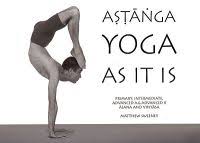
Matthew Sweeny's Astanga As it is
John Scott's Ashtanga Yoga

Ashtanga Yoga Practice & Philosophy
by Gregor Maehle
--------------------
I'm looking at my copy of Pattabhi Jois' Yoga Mala now, ONE Ashtanga book, ONLY ONE?
Yep Yoga Mala.
Of course Yoga Mala, there's more Krishnamacharya in it than in all the others, in fact I tend to think of Pattabhi Jois typing Yoga mala up with a battered copy of Yoga Makaranda in Kananda on his desk beside him.
It's an elegant book, a bugger to work from in home practice perhaps and I put mine to one side again and again, but I kept coming back.... I keep coming back.
There are treasures awaiting the first second, tenth reading.
It gets interesting if you allow yourself TWO books or say that Yoga Mala is a given (of course you're going to buy Yoga Mala), what else, which other Ashtanga book if you could buy ONLY ONE more.
Hmmmmmmm...... Help me on this because I can't really say for the Shala Ashtangi having only been to a shala twice in seven years. I should probably go with Sharath's book, as Steve points out, it's probably got all you need for day one. Still, I think I'd have to go with Petri Räisänen's 'Definitive Primary Series Practice Manual' and hope that your Shala gave you a printed out cheat sheet of the sequence as described in Sharath's book or included a copy in your first months membership. Petri's book has the 'official', current, up-to-date Ashtanga sequence but also mentions some of the variations that you might encounter in your own particular Shala and it's teacher(s). There's a lot of Pattabhi Jois' wisdom in it, Petri asked a LOT of questions plus there's much else besides.
|
| My uninformed choice for the Shala Ashtangi |
But what about the Home Ashtanga, the teach yourself Ashtangi. John Scott's is excellent, all you need to get started although I think I started with Tara Frazer's from my local library but I've always tended to go with David Swenson. It's true you wont need the second series for at least a year or so but he provides you with variations of each and every posture as well as shorter versions of the practice for when your working towards a full practice or actually have a life outside Ashtanga.
But it's got competition, Kino's book is excellent for the Home Ashtangi lots of tips and hints, as is Gregor's and with it's excellent anatomy side panels...
NO, I'm going to stick with David Swenson (sorry Kino), if only for the clear, simple, layout and the intelligent shorter versions of the practice in the back.
|
| STILL my informed choice for the Home Ashtangi |
And in an extra category, for the Ashtanga blogger
| My choice for the Ashtanga blogger, couldn't blog without it. |


24 comments:
Kino, hands down. Don't know why, but it really clicked with me and I love everything about it.
I hear you Kitharo, but I think I'm choosing here for somebody buying their first and only book 9apart from yoga mala) For me personally now i don't need the variations David lists or the shorter sequences so I'd go with the Kino's too.
Thank you for commenting and having that huge long blog list when i click on your name. I lost my blog list two years ago and had to rebuild it from memory and other blog lists. I've found several blogs on your list that had lost, old friends as well as some I've not come across before.
For me it's Matthew Sweeney, Astanga yoga as it is!
John Scott gets my vote. Keep referring to it when doing my home practice to learn the correct vinyasas. The book is propped open using a block during practice (is this allowed??).. I like the simple layout. Each posture is presented in two pages side-by-side, with step-by-step approach. This is my beginner's opinion! (HD)
This was just the question on my mind---which book to refer to---a very timely post; thank you! There was already a copy of "Light on Yoga" by B.K.S. Iyengar at home that I was looking up in case of doubts. Have you seen this book? Any comments?
Also, with sincere apologies for my ignorance and not doing enough to find about abuot this on my own, there is another request: Would you please explain briefly what distinguishes the different types of yoga: Iyengar's yoga, Vinyasakrama Yoga, Ashtanga Yoga and Makaranda... from each other? Isn't there just one "Yoga sutras"? So how come there are so many "flavors" and which is the one that follows the description in the Patanjali sutra-s most closely? Sincere thanks for the help!
Can I pop in another front-runner in my collection?
'Guruji'. I'm on my second pass of that now, and to read direct insights from, now, senior teachers sharing their discoveries, takes the practice to a whole different level. I sincerely wish that had been available to read a decade and a half ago. Not only would it have elevated and corrected my practice a lot earlier, but it may also have helped me jump of my, what I thought at the time, was a career path way (treadmill), way earlier and migrate to the much richer world of Ashtanga Yoga.
Sanson's description of practicing alongside Indian students, and how different they were to the Westerners was an education in itself.
Well for an absolute beginner, I'd probably go with Tara Frasers book, it taught me well, I think :-)
Haha I just checked and my blog list really got insanely long. Not all yoga, but I'm mostly yoga blog addicted... glad you got some new and old blogs out of it, I love the community!
Yes, should add Guruji under 'special mentions'. Not a laying out of the series perhaps but no doubt says more about the practice than all the rest combined. I tend to think of it as a game changer. Up until it was published I received a lot of dogmatic comments along the lines of 'the only correct approach to practice', that all (...mostly) changed after Guruji. Here was a book that showed how Pattabhi Jois had taken a different approach to teaching the practice depending on the student (and the period) and that it was all good. Difficult to be SO dogmatic after that.
Interesting coming back to it (again and again) chapters you kind of skimmed through and were perhaps less interested in on one reading become your favourites on another....perhaps reflecting our own shifting focus on aspects of practice. Great book.
I must have written a review of it somewhere but can't seem to find it, want to add it to my reviews page.
Damn, just noticed, I missed my counter click over 1,111,111.
Sad i know but have been looking forward to that for the last couple of weeks
Hi HD : )
YES, love John Scott's book, can't believe I've never done a proper review of it, am planning one. Yes great beginners book but also so much there for somebody who has been practicing for a while with it's excellent introductions to each postures and to each part of the sequence. Thanks for the reminder.
It's probably the one I would loan out more if I could bare to risk parting with it...tend to lend out the one by Tara Frazer.
You started with Tara's too, it is a good layout, variations of postures too similar to David Swenson's approach. In fact it's kind of a blend of John Scott's and David Swenson's.
Lots of Kundalini blogs I notice on your list. Always wanted to take a proper look at it but the big (high) white turbans always put me off a bit....if you were to recommend ONE Kundalini blog?
think I have four copies of Light on Yoga around the house. In fact I remember having a copy back in my late teens. Love the poetical description of the postures, still use it for reference sometimes. Not on the lists above because these are all Ashtanga books
I will have a go Anon.
Yes of course only one Patanjali Yoga Sutras which lays out the eight (ashtanga) limb approach.
Krishnamacharya wrtote Yoga makaranda in the 1930s and presented an approach to practicing Patanjali's Yoga Sutras with help from the Hatha Yoga pradipka.
Krishnamacharya, In presenting asana in his book , rather than just sitting down and doing a posture then getting up and doing another postures, he focussed on the breath at every stage. So you would begin a posture, usually from standing and then get to the posture with every movement having it's own along, slow, full inhalation or exhalation. Then you would stay in the posture for a time focussing on the breath (as well as perhaps retaining it) before moving back to standing again with each movement having it's own proscribed inhalation or exhalation. Each inhalation and exhalation would have it's own count (Vinyasa count), so one posture beginning at standing, moving through to the actual asana and back to standing might have a total of five movements, five vinyasas, five inhalations and exhalations in total, another might have seventeen or twenty -two, if counting both sides of the bodyand depending on how complicated or involved the asana.
Later in his other book Yogasanagalu he put beginner postures together in one group , intermediate postures in another group and the rest in a group called advanced.
This grouping is basically the Ashtanga method of Pattabhi Jois. the grouping has changed a little, become more fixed, plus you might not go all the way back to standing after each posture (full posture) but just back to downward facing dog before moving into the next posture on the breath( half vinyasa). there is still a strong focus on the breath, the gaze and the bandhas as outlined in Krishnamacharya's Yoga makaranda.
That linking of the postures characterises Ashtanga as well as the mostly fixed sequences. Because the sequence is fixed and we have a lot of postures to get through the breath seems to have speeded up a little and there tend to be no breath retentions in the postures.
Ramaswami's Vinyasa Krama is very much like Ashtanga but the breathing is still very long and slow and this is partly because the sequence is less fixed, although postures still tend to be related, one leading into another, simple to more difficult perhaps. We might do less postures but stay in them longer or repeat them. Vinyasa krama also stresses the integrated nature of the practice, the importance of practicing asana, pranayama, pratyahara and some meditative activity in every practice just as Krishnamacharya had stressed.
I can only really talk about Ashtanga and Vinyasa krama having only practiced a little of Iyengar and the Desikachar/Mohan approach but I'll have a go at this too.
Iyengar doesn't seem to have a 'fixed' sequence, the postures seem to be taken more individually although several postures may make up a practice that will have a logical connection to the needs of that morning (or evenings) practice. There is a strong focus on the asana itself and it's effects and thus a strong focus on the alignment so as to achieve that effect.
Desikacha and Mohan's approach, two more students of Krishnamacharya, often focus on the therapeutic aspect of practice. there is a strong focus on the breath and of linking postures to the needs of the student for that particular practice session.
Yes, I stumbled upon it in my library after I tried some Ashtanga DVDs and it really helped me to establish a Mysore practice at home, because she explains very good, but not too much. I guess the "too much" would be a vote against Kino's book, if it's intented for a beginner. More people should buy Tara's book!
Kundalini yogis don't blog as much, unfortunately. I always try to find blogs, but mostly they blog very rarely or stop after a while. I guess it's because with all the sets you don't have such a daily mirror like you do with your Ashtanga practice. You get confronted with a lot, but... I don't know, I think it's different to blog about. One good blog is Sat Inders blog: http://yogiinthesun.blogspot.de/
I think you will like it, because he's an Ashtangi and in 2009 and 2010 (or 2011, I'm not sure) he almost exclusivly practiced Kundalini and blogged a lot about it. How it's different to Ashtanga and how it improves his Ashtanga practice and so on... I think it can be interesting to go back to this old posts and read through them, because he's a really good blogger.
As for the turbans :-) don't let them scare you. They kept me away from KY for a while, because let's face it, cult is the only word that comes to mind, but most KY teachers are really down to earth. I'd really recommend a live class... of course the experience depends on the teacher, but if you happen to have a good, down-to-earth and not to woo woo teacher, it's really amazing.
Since you're a home Ashtangi... if you'd like to try KY some time with DVDs, I'd absolutely recommend Maya Fiennes "A Journey Through The Chakras"... very well produced and not to out there (except for some statements) and I think for a dip in the KY world, that could be nice.
Ok long post, but it's rare to talk about KY in the blogsphere, so I couldn't resist.
Yes, excellent Ursula, especially the section on method at the beginning, i should reread it as it's been a while.
Hi Grimmly, sorry to hear of your back woes...
Which book by John Scott is this? I found his DVD on the primary series on YouTube and was following along to that, until it was removed. So now I'm following along to Guruji in the Primary series with those teachers in the 90s...I still can't do much, so it's not like I get very far before I'm exhausted or the muscles aching or the loss of balance overtakes me...sooo frustrating, in spite of which I'm trying to get on the mat (despite young children underfoot) 2-3 times a week...some days all I do is the Suryas A and B and I'm spent (how unfit is that!:() and other days I manage to get a bit further. I HAVE noticed though that there's now a bit of a rhythm to it, and I AM becoming more flexible, ...but like you were,I'm overweight ATM which doesn't help ...trying to be patient and to do what I can. (Imaan)
This is the book, you can have a 'preview' of it on amazon
http://www.amazon.com/Ashtanga-Yoga-Definitive-Step---Step/dp/0609807862/ref=sr_1_1?ie=UTF8&qid=1372596417&sr=8-1&keywords=john+scott
Mark Darby's DVD is more appropriate for beginners, as he gives modifications. Perhaps aim to complete the standing sequence, then slowly introduce seated poses, leading up to navasana. I'm only doing half primary at the moment, and am perfectly content with that :) so much to learn
Try to attend some workshops if there is any near you, totally recommend Swenson's Intro to Asthanga and Half primary workshop
Let's look forward to 2,222,222 :D
HD
Yes, the John Scott book is excellent, tough choice between that and the Swenson. I found John Scott's DVD intimidating in the beginning (but it's beautiful to just watch) and agree with Anon 2 that Mark Darby's DVD is better for beginners, (there is a review on my Review page at the top of the blog), it's the DVD I learned with and excellent for keeping you safe.
Sorry, if my comment is only loosely connected to the current blog post, but somehow it is. :)
Maybe my questions are not appropriate, maybe unnecessary, maybe too petty, but there is a small but...
I checked again and deeply Yoga Makaranda, Yoga Mala and some of the contemporary ones (Larry Schultz and Gregor Maehle), also Nancy's 1974 syllabus.
1. It is interesting, that Yoga Mala says in the state of the asana "rechaka and puraka should be done slowly and as much as possible". I like this approach.
2. Even Padangushtasana is different to Yoga Makaranda. It says when coming up "Next, inhaling, slowly lift the head, remaining in position with the fingers holding the big toes; this is the 3rd vinyasa. Then exhale and return to Samasthiti. ". I like Ramaswami's teaching (inhale when lengthening the spine, coming up, or bending back, and exhale, when doing the opposites.)
3. I like the idea that Padangushtasana and Padahastasana is not tied together, both vinyasas are started from Tadasana/Samasthiti. Maybe this is related to full vinyasas, I reckon.
4. Yoga Makaranda and Yoga Mala does not mention Parivritta Trikonasana and Parivrita Parshvakonasana at all (I was not able to find). Wonder when these came into the picture. Also not part of Nancy's syllabus.
5. Nancy's syllabus mentions Yoga Mala part1 as a theory section of the first year, I wonder if there is Yoga Mala part 2. somewhere?!
6. Bhujapidasana in Yoga Mala does not mention Titthibasana and doesn't place the top of the head but the chin on the floor when in the state of the asana. Maybe Bakasana is in YM as I was able to check. But Bhujapidasana in Yoga Makaranda is again, a but different, I think.
It is funny, that it doesn't point to sury as starting sequence, but says Vinyasas 1 to 6 are like pascimottanasana...
Maybe there are other differences as well, now I stick to Yoga Mala (like the Yoga Makaranda-ish aspects).
I wonder if this comment could serve another blog post topic?! :) I know you wrote several posts about similar thoughts.
May I suggest Kino's Intro to ashtanga class.. hope this is okay, Grimmly..
http://www.myyogaonline.com/videos/yoga/introduction-to-ashtanga-yoga-extended
She led the class up to Ardha Baddha Padma Paschimattanasana, then on to Urdhva Dhanurasana, then closing posture. and we love Kino, so encouraging and so much info/tips given in her class :)
HD
Sorry to be nagging with Q's in the same vein again... I find that having to read/ refer to a book (on the next asana or how it ought to be approached) in the middle of the practice just makes it longer (so fewer asana-s on a week day). So, practicing along with a video (Primary led by Jois or the six videos of Vinyasakrama led by Ramaswamy on youtube) is a big help. In response to an earlier Q you had clarified that it is not practical to expect to get into a Paschi or Baddha Konasana within a few days of starting to practice. So, is it a good option to work with one of the videos (J's or R's) as a beginner? My question really is, ought I to follow through the instructions on the video, such as "jump back" or "jump through" sloppily (as best as possible) or just "walk" back/ forward and sit through AsanA-s that are difficult to get into?
Wish you a speedy recovery and as painless and early an exit of the stone as possible!
Try this video Anon, it's the one I learned the practice with
http://youtu.be/http://youtu.be/gNdoCC8NlL4.
You get the asana as well as a variation and lots I safety tips throughout, I highly recommend buying this DVD. Do just the standing postures perhaps until you can remember them then start adding on the seated postures, the important thing is to be able to remember them and the order so you don't have to uses a book or DVD every practice. Don't worry about jumping buck...try to lift up just to build strength but then step back, it'll come. Try to get David Swenson's book it has easier variations for each posture. The Jois led Primary presumes that you have already learned the practice, not ideal for learning with
Post a Comment
Note: only a member of this blog may post a comment.