NOTE: Blog address now begins grimmly1997. I've unpublished 80% of posts but retained, on request, the Krishnamacharya 'Research' posts.
Comments are turned off, there are no blog "members".
NOTE 2: If you have landed on the mobile page, you need to scroll down and click on web version to get all the stand alone pages on Krishnamacharya, Asana lists, Yogasanagalu, Proficient Primary etc.
Thank you to Scott for the invitation to come and present my original Krishnamacharya Ashtanga and Vinyasa Krama workshop at home in London. pleasure to have tohe opportunity to work with my friend Mick who gave a presentation on health and Kumbhaka as part of the workshop.
Sure I've seen this picture elsewhere, the house isn't shown in the original, a child's imagination?
In my post yesterday I embedded the documentary concerning Krishnamacharya's 100 year centenary celebrations. In the post I pick out a few highlights. One of them at 21:20
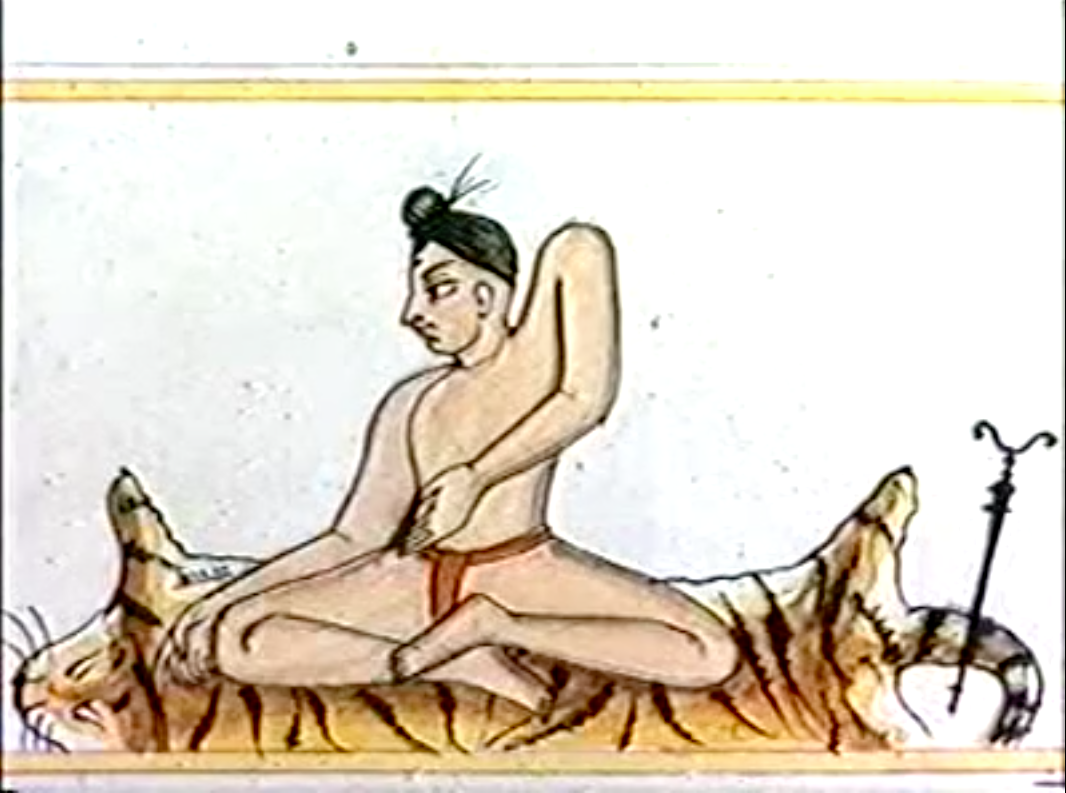
"...was of drawings said to be by Krishnamacharya's teacher in Tibet, Yogeshwara Ramamohana Brahmachari's daughter. I remember seeing two of these drawings in a Biography of Krishnamacrya, wonderful to see more of them. Isn't this a distinctive south Indian style of representation? Reminds me of those in Norman E. Sjoman, The Yoga Tradition of the Mysore Palace".
I couldn't resist following this up and doing a comparison of the pictures shown in the documentary and those in Norman's book taken from Sriitattvanidhi (1880s).
And they match up, the same images and yet slightly different, certainly more colourful, fresher, as if they had indeed been copied.
Sometimes, where pictures are placed together, they are in the same order as if (lets stick with the Ramamohana Brahmachari's daughter drawing them explanation) they had indeed been copied BUT from the/an original text, how did that come about?
I also checked and found that the four pictures (see towards thee end of the post) I had seen before in Krishnamachary's biography were different but that those pictures matched up with the original text also. This means that the book that Krishnamacharya supposedly brought back from Tibet has more pictures, one wonders how many, is it a complete copy of all the asana pictures in Sriitattvanidhi?
If the daughter story is true then Krishnamacharya had access to the book and we assume the text ( or his teachers teaching of the text) much earlier than Norman Sjoman suggests, in Tibet rather than Mysore.
Either that or perhaps Krishnamacharya copied the pictures himself in Mysore, a possibility.
I've always found these pictures to be dynamic, there is movement here, a vinyasa tradition perhaps?
I don't know what this all means for the history of modern postural practice but fascinating stuff, will need to have a think and chew on it a while.
I'll be teaching a Workshop on Krishnamacharya at StillPoint Yoga London this Sunday, perhaps we can discuss it at the end.
Norman Sjoman's book is essential reading if your interested in this work, Mark Singleton Yoga Body is heavenly indebted to Norman's text. As well as presenting the full text Norman translates all the instructions.
"The book (Yoga Tradition of the Mysore Palace) presents the first English translation of a part of kautuka nidhi; Sritattvanidhi, which includes instructions for and illustrations of 122 postures—making it by far the most elaborate text on asanas in existence before the twentieth century. The book includes instructions for 122 yoga poses, illustrated by stylized drawings of an Indian man in a topknot and loincloth. Most of these poses—which include handstands, backbends, foot-behind-the-head poses, Lotus variations, and rope exercises—are familiar to modern practitioners (although most of the Sanskrit names are different from the ones they are known by today). But they are far more elaborate than anything depicted in other pre-twentieth-century texts".
"The Sritattvanidhi (Śrītattvanidhi) ("The Illustrious Treasure of Realities") is an iconographic treatise written in the 19th century in Karnataka by the then Maharaja of Mysore, Krishnaraja Wodeyar III (b. 1794 - d. 1868). The Maharaja was a great patron of art and learning and was himself a scholar and writer. There are around 50 works ascribed to him.[1] The first page of the Sritattvanidhi attributes authorship of the work to the Maharaja himself:"
Wikipedia
Keeps the legs comfortably together for meditation, Norman Sjoman discussed this on a recent workshop I took with him.
From Sritattvanidhi (1800's) in Yoga tradition of the Mysore palace
How the pictures are presented in the 'original' Sritattvanidhi
And there's more.....
I mentioned that I had seen a couple of pictures that were supposed have been drawn by Krishnamacharya's teacher's daughter in a biography of Krishnamacharya. I remembered that I had posted them on a blog post and managed to find them, here they are in Sriitattvanidhi.
In Norman's book he names the asana and gives translations of the instructions/descriptions found above the pictures.
And YES, these too are in Sriitattvanidhi
A review of the argument in Norman's book from 2007
From Yoga Journal AUG 28, 2007
Previously Untold Yoga History Sheds New Light
BY ANNE CUSHMAN |
"The Mysore Palace
I found myself pondering these questions afresh recently after I came across a dense little book called The Yoga Tradition of the Mysore Palace by a Sanskrit scholar and hatha yoga student named Norman Sjoman. The book presents the first English translation of a yoga manual from the 1800s, which includes instructions for and illustrations of 122 postures—making it by far the most elaborate text on asanas in existence before the twentieth century. Entitled the Sritattvanidhi (pronounced “shree-tot-van-EE-dee”), the exquisitely illustrated manual was written by a prince in the Mysore Palace—a member of the same royal family that, a century later, would become the patron of yoga master Krishnamacharya and his world-famous students, B.K.S. Iyengar and Pattabhi Jois.
Sjoman first unearthed the Sritattvanidhi in the mid-1980s, as he was doing research in the private library of the Maharaja of Mysore. Dating from the early 1800s—the height of Mysore’s fame as a center of Indian arts, spirituality, and culture—the Sritattvanidhi was a compendium of classical information about a wide variety of subjects: deities, music, meditation, games, yoga, and natural history. It was compiled by Mummadi Krishnaraja Wodeyar, a renowned patron of education and the arts. Installed as a puppet Maharaja at age 5 by the British colonialists—and deposed by them for incompetence at the age of 36—Mummadi Krishnaraja Wodeyar devoted the rest of his life to studying and recording the classical wisdom of India.
At the time Sjoman discovered the manuscript, he had spent almost 20 years studying Sanskrit and Indian philosophy with pundits in Pune and Mysore. But his academic interests were balanced by years of study with hatha yoga masters Iyengar and Jois. As a yoga student, Sjoman was most intrigued by the section of the manuscript dealing with hatha yoga.
Sjoman knew that the Mysore Palace had long been a hub of yoga: Two of the most popular styles of yoga today—Iyengar and Ashtanga, whose precision and athleticism have profoundly influenced all contemporary yoga—have their roots there. From around 1930 until the late 1940s, the Maharaja of Mysore sponsored a yoga school in the palace, run by Krishnamacharya—and the young Iyengar and Jois were both among his students. The Maharaja funded Krishnamacharya and his yoga protégés to travel all over India giving yoga demonstrations, thereby encouraging an enormous popular revival of yoga. It was the Maharaja who paid for the now well-known 1930s film of Iyengar and Jois as teenagers demonstrating asanas—the earliest footage of yogis in action.
But as the Sritattvanidhi proves, the Mysore royal family’s enthusiasm for yoga went back at least a century earlier. The Sritattvanidhi includes instructions for 122 yoga poses, illustrated by stylized drawings of an Indian man in a topknot and loincloth. Most of these poses—which include handstands, backbends, foot-behind-the-head poses, Lotus variations, and rope exercises—are familiar to modern practitioners (although most of the Sanskrit names are different from the ones they are known by today). But they are far more elaborate than anything depicted in other pre-twentieth-century texts. The Sritattvanidhi, as Norman Sjoman instantly realized, was a missing link in the fragmented history of hatha yoga.
“This is the first textual evidence we have of a flourishing, well-developed asana system existing before the twentieth century—and in academic systems, textual evidence is what counts,” says Sjoman. “The manuscript points to tremendous yogic activity going on in that time period—and having that much textual documentation indicates a practice tradition at least 50 to 100 years older.”
Potpourri Lineage
Unlike earlier texts such as the Hatha Yoga Pradipika, the Sritattvanidhi doesn’t focus on the meditative or philosophical aspects of yoga; it doesn’t chart the nadis and chakras (the channels and hubs of subtle energy); it doesn’t teach Pranayama (breathing exercises) or bandhas (energy locks). It’s the first known yogic text devoted entirely to asana practice—a prototypical “yoga workout.”
Hatha yoga students may find this text of interest simply as a novelty—a relic of a “yoga boom” of two centuries ago. (Future generations may pore with equal fascination over “Buns of Steel” yoga videos.) But buried in Sjoman’s somewhat abstruse commentary are some claims that shed new light on the history of hatha yoga—and, in the process, may call into question some cherished myths.
According to Sjoman, the Sritattvanidhi—or the broader yoga tradition it reflects—appears to be one of the sources for the yoga techniques taught by Krishnamacharya and passed on by Iyengar and Jois. In fact, the manuscript is listed as a resource in the bibliography of Krishnamacharya’s very first book on yoga, which was published—under the patronage of the Maharaja of Mysore—in the early 1930s. The Sritattvanidhi depicts dozens of poses that are depicted in Light on Yoga and practiced as part of the Ashtanga vinyasa series, but that don’t show up in any older texts.
But while the Sritattvanidhi extends the written history of the asanas a hundred years further back than has previously been documented, it does not support the popular myth of a monolithic, unchanging tradition of yoga poses. Rather, Sjoman says that the yoga section of the Sritattvanidhi is itself clearly a compilation, drawing on techniques from a wide range of disparate traditions. In addition to variations on poses from earlier yogic texts, it includes such things as the rope exercises used by Indian wrestlers and the danda push-ups developed at the vyayamasalas, the indigenous Indian gymnasiums. (In the twentieth century, these push-ups begin to show up as Chaturanga Dandasana, part of the Sun Salutation). In the Sritattvanidhi, these physical techniques are for the first time given yogic names and symbolism and incorporated into the body of yogic knowledge. The text reflects a practice tradition that is dynamic, creative, and syncretistic, rather than fixed and static. It does not limit itself to the asana systems described in more ancient texts: Instead, it builds on them".
Fu;; article here http://www.yogajournal.com/article/philosophy/new-light-on-yoga/
Paul Harvey posted on FB yesterday morning, a link to a download on his site of a Krishnamacharya documentary '100 Years Of beatitude', marking Krishnamacharys 100th birthday celebrations.You can download the movie here on Pauls excellent resource pages at Yogastudies.org I've embedded the movie at the bottom of this post.
Here are a couple of scenes that stood out for me the first is quite astounding (I've given the time so you can skip through the movie to the clip).
1.
24:55 It seems to be a scene left out of the familiar 1938 B and W documentary footage, I've certainly never seen it before. We see Krishnamacharya raise his padmasana (lotus) turn it through his arms 180 degrees and drop it to the mat before repeating it on the other side.
We shouldn't be surprised some nice padmasana work appears in the 1938 movie include Krishnamacharya snapping his legs into lotus while in utpluthi,
Party tricks?
This dropping of the lotus seems to be Krishnamacharya's take perhaps on mahavedha (mahaveda, maha veda)
from Hatha Yoga Pradipka
"The mahâ Vedha अथ भहावधे ्
भहाफन्धश्चस्थतोमोगीकॄत्वाऩयूकभके धी्।
वामनू ाॊ गश्चतभावॄत्य श्चनबतॄ ॊ कण्िभद्रु मा ॥२६॥
Atha mahāvedhah
Mahābandhasthito yogī krtvā pūrakamekadhīh
Vāyūnām ghatimāvrtya nibhrtam kanthamudrayā
Sitting with mahâ Bandha, the Yogî should fill in the air
and keep his mind collected. The movements of the
Vâyus (Prâna and Apâna) should be stopped by closing
the throat.)
सभहस्तमगुोबभूौश्चस्फचौसतॊािमच्छे न्ै।
ऩ टु द्व म भ श्च त ि म्य व ा म ् ु स्फ ु य श्च त भ ध्य ग ् ॥ २ ७ ॥
Samahastayugho bhūmau sphichau sanādayechchanaih
Putadvayamatikramya vāyuh sphurati madhyaghah
Resting both the hands equally on the ground, he should
raise himself a little and strike his buttocks against the
ground gently. The air, leaving both the passages
namely Idâ and Pingalâ, starts into the middle one".
2.
26:57 TKV. Desikachar pointing out the folds in Krishnamacharya's back as he engages mula bandha fully
3.
25:40 TKV Desikachar Suggesting that Krishnamacharya invented Vinyasa Krama to allow students who didn't have the possibility of spending 1-2 hours on asana to benefit from a variety of asana Have to remember this is very much a Viniyoga perspective on things.
4.
21:20 Drawings said to be by Krishnamacharya's teacher in Tibet, Yogeshwara Ramamohana Brahmachari's daughter. I remember seeing two of these drawings in a Biography of Krishnamacrya, wonderful to see more of them. Isn't this a distinctive south Indian style of representation? Reminds me of those in Norman E. Sjoman, The Yoga Tradition of the Mysore Palace,
Here's the full movie from KYM, on Youtube which allows me to embed the movie here.
I'll be presenting a workshop on Krishnamacharya StillPoint Yoga London next Sunday (still places)
September 2014 Newsletter from Srivatsa Ramaswami— vyāhṛti (व्याहृति) I completed teaching the 200 hr Teacher Training Program at Loyola Marymount University by Aug 10th. I now find it a bit difficult to teach for 7 hrs a day for 5 weeks at a stretch. We may offer the program next time at two separate times for about 2 1/2 weeks to three weeks each. The program went off well, it was a very satisfying experience with a bunch of adorable participants. I also taught a one day program on Vinyasakrama at Ananda Ashram in NY state Immediately thereafter I came to Chennai on Aug 15th for attending to a nagging personal problem which is getting dragged. I was planning to return to US on Sep15 to go to Chicago to teach a program at Chicago Yoga Center, then a weekend program at Anand Ashram in October and possibly teach a seminar at Princeton University in December. Everything appears to be uncertain until this issue is sorted out. I am also scheduled to teach the entire Bhagavat Gita verse by verse as I studied with Sri Krishnamacharya. This 70 hr program would be in May 2015 at my friend Steve Brandon's Harmony Yoga in UK. But first the Uncertainties! Vyāhṛti-व्याहृति The two most important mantras of the Vedas are Pranava (OM) and then the Gāytri. There is another mantra or a group of mantras used extensively, the vyahritis. Ahriti is to hold back whereas Vyahriti is to give out and hence these vyahriti mantras are known as utterances. There are seven vyahritis out of which the first three are very commonly used. They are also called mahavyahritis or great utterances. The seven utterances are bhuh, bhuvah, suvah, mahah, janah, tapah, satyam. What do they convey, what do they represent? According to one school especially the purnic school, the seven vyahritis represent the seven worlds starting from the world we are in, the bhu loka. Then the rest of the six worlds are the higher worlds. Due to one's good karma one is able to traverse to higher worlds in successive births. The first three vyahritis are more commonly used and are known according to some authorities as Maha Vyahritis or the great utterances. In Indian especially South Indian dishes turmeric is invariable added, like in curries, sambar (soups), rasam. It is an integral part of pujas or worships. Many women in olden days used to smear themselves with turmeric paste before or while taking bath as skin conditioner and use it also as a facial base. Sometimes the mahavyahritis can be considered as essential concomitant mantra like turmeric is in daily life. So one may call, the vyahritis as mantra turmeric. Om burbhuvassuvaH is how one starts the pariseshana mantra or the food purification mantra before one starts to eat food. One takes a spoonful of water in the right hand and sprinkle it on the food (usually cooked rice) saying Om bhurbhuvassuvaH. Then one would proceed to to do the parseshana mantra when water is dripped around the plate or the plantain leaf on which the food is served. Thereafter one would pick up with the thumb and the ring finger, one cooked grain of rice and put it into the mouth hailing the five pranas one by one and finally the Brahman the ultimate reality. It is a beautiful cute meaningful ritual at the start of taking food. Taittiriya upanishad talks about the fourth vyahriti. “There are three vyahritis, BhuH, BhuvaH and SuvaH. Beyond them is the one, the fourth, Maha(t) says the great sage Mahachamasya. That is Brahma(n). That is Atman or individual Self. (Maha iti| tat brahma| sa atma||” It could be seen that the Upanishad says that MahaH is Brahman or the ultimate reality. And what is Brahman The upanishad elsewhere defines Brahman as “Satyam, jnanam anantam brahma” Satya would mean Truth or one that really exists. It is something that is not affected by time as truth is not affected by time. Secondly it is jnana or consciousness and finally it is ananta or it is everywhere or something unaffected by space. So the definition of Brahman is pure consciousness unaffected by time or space. Here advaitins tend to take heart in the statement that the brahman is the atman or the self in each of us. They say Brahman and atman are one and the same, not different from each other-- that it is advaita. The upanishad helps to understand these mystic vyahriti mantras.by relating them to something known to us. The first vyahriti can be related to this world (ayam lokah) or the bhuta, agni or fire, or the brilliant sun or the rig veda mantra (rik) or prana or the life force itself. Then the next vyahriti 'BhuvaH' may be related to inter-space (antariksha), or the bhuta, vayu or air, or the sama veda mantra or the physiological principle apana. The third vyahriti 'suvaH' would relate to the heaven, or the sun or the yajur veda mantra or the vyana vayu in the body. Finally the mahat could be related to aditya or the sun, or chandrma the moon, or Brahman the ultimate reality and also food which sustains life of all beings. Thus one should be contemplating on the four vyahritis as per the upanishad Again there are vedic passages that refer to not just three or four but seven vyahritis, BhuH, bhuvaH, suvaH, mahaH, janaH, tapaH, satyaM (OM bhur-bhuvas-suvar-mahar-janas-tapas-satyaM). These seven vyahritis are referred to as seven worlds or lokas as mentioned earlier. However these lokas are also related to the seven states of consciousness. According to taittiriya upanishad, Brahman, alone and immortal, pure consciousness desired to become many “bahusyam prajaayeyeti”. Then it contemplated or was in a state of tapas. This perception (aaloka) of the brahman in known as tapoloka even as it is interpreted in puranas as a world by itself. After deep contemplation Brahman created the entire universe. This state of the supreme consciousness came to be known as jana loka. Having created it the Brahman entered into each one of its creation and became the Self of everything, everyone. In this microcosmic state it had three experiences one with the waking state, one with the dream state and one with the deep sleep state. Mahachamasya after deep yogic contemplation realized that there was a fourth state of this consciousness which transcended all the three other individual states of consciousness. So we have three levels of ordinary consciousness at the individual or microcosmic level represented by the three vyahritis bhuH, bhuvaH and suvaH. Then the fourth level is the yogic state which the upanishads call as turiya or the maha loka. But since the same consciousness is also the one from which everything came about, the three state of super or cosmic or macro-cosmic consciousness will be the jano loka, tapo loka and satya loka. This ideation is used in the pranayama mantra which proclaims that the same consciousness can be viewed to have seven states four at the microcosmic state and three at the cosmic state. In all brahman as atman or individual self is in the pure state of consciousness (atman or drashta) at the fourth state represented by the vyahriti mahat. And at the cosmic level it is in its pristine glory bereft of any creation or ideation and is represented by the vyahriti 'satya'. Yoga helps to realize the pure consciousness at the individual level (kaivalya, turiya) wheras vedanta helps to realize the same consciousness at the cosmic level (moksha) The vyahritis therefore are very important mantras next only to Pranava (OM) and the gayatri. In fact when we chant the gayatri three times a day (gayatri japa) during the sandhya, the gayatri mantra is chanted (japa) not alone but preceded by pranava and the three vyahritis Om (Pranava) bhur-bhuvas-suvaH (the vyahritis) tat-savitur-varenyaM (I pada of gayatri) bhargo-devasya-dhimahi (II pada of gayatri) dhiyo-yonaH-prachidayat (III pada of gayatri)
Pranava, vyahritis and Gayatri are beautiful, highly potent and meaningful mantras of the vedas.