Tuesday, 15 March 2016

But wasn't it always a circus. Distractions and the rise of the Ashtanga Video tutorial and Ashtanga workshop.

If this blog is about anything it's about the changing/shifting relationship to the practice and all it's aspects. Sometimes it's viewed in a positive light at other times less so while all the time continuing to practice.  On the pages above you'll find a page devoted to reviews of workshop, this post questions them.

I put up some titles of posts in draft yesterday that stretched back years and asked if anyone wanted to see any of them turned into post, here's the first


Pattabhi Jois' letter to Yoga Journal is doing the rounds again, warning about Ashtanga being turned into a circus.

"I was disappointed to find that so many novice students have taken Ashtanga yoga and have turned it into a circus for their own fame and profit (Power Yoga, Jan/Feb 1995). The title 'Power Yoga' itself degrades the depth, purpose and method of the yoga system that I received from my guru, Sri. T. Krishnamacharya. Power is the property of God. It is not something to be collected for one's ego. Partial yoga methods out of line with their internal purpose can build up the 'six enemies' (desire, anger, greed, illusion, infatuation and envy) around the heart. The full ashtanga system practiced with devotion leads to freedom within one's heart. The Yoga Sutra II.28 confirms this 'Yogaanganusthanat asuddiksaye jnanadiptih avivekakhyateh', which means 'practicing all the aspects of yoga destroys the impurities so that the light of knowledge and discrimination shines'. It is unfortunate that students who have not yet matured in their own practice have changed the method and have cut out the essence of an ancient lineage to accommodate their own limitations.
The Ashtanga yoga system should never be confused with 'power yoga' or any whimsical creation which goes against the tradition of the many types of yoga shastras (scriptures). It would be a shame to lose the precious jewel of liberation in the mud of ignorant body building."
-K. Pattabhi Jois, Ashtanga Yoga Research Institute, Mysore, South India

See this post for a closer look at what Pattabhi Jois was responding to.


Krishnamacharya was turning the young boys into asana demonstrators in his school in the Mysore Palace, thus the strictness no doubt, the reports of beatings. The better demonstrators, Pattabhi Jois among them would perform asana while Krishnamacharya would give his Yoga philosophy lectures, perhaps his irritability at this time stemmed from knowing everyone was only interested in the circus and not the philosophy or what he found buried within asana. Pattabhi Jois took that circus aspect, the demonstration training and turned Krishnamacharya's flexible groups of asana into fixed sequences. We've been focused on demonstration ever since, it was what drew the early Ashtangi's to Mysore and no doubt continues to do so, perhaps it's the circus that draws us to the practice more than we care to admit. 


Occasionally the practice, the asana, does it's/their job and we find ourselves in an asana, a group of asana and the world drops away, this happens even more in many pranayama find, attachment is loosened a little.... unfortunately it's no doubt around then that we get given (or choose) another asana and another sequence or another technique for achieving an asana beckons, or the possibility of teaching or giving a workshop or making a video, the bright lights of the circus moving from one town to another town and another and another.

Pattabhi Jois warned of it in his letter but it was built into or a trap hidden within the very system he was presenting, he got off the merry-go-round himself supposedly (to shift metaphors ) and focused, in his own practice, on the long stays, on the breath that his teacher no doubt stressed, why didn't he think we were ready for that. Perhaps he knew us too well and that if he made us stay in paschimattanasana for ten minutes or had us go to finishing after navasana and do 80 rounds of pranayama we wouldn't have come back, not stayed the course. 

But how long are we going to work on our circus skills? Gymnast, Contortionists, Circus performers are all just as focussed, just as disciplined, just as devoted and dedicated to their art, how do we differ from them if not in purpose. Why are we practicing, why getting up every morning... why putting ourselves through this, we know there is something more, something deeper, why do we keep putting it off, finding ever more distractions. One asana is enough, one asana was no doubt always enough.

It was the same in Zen of course and in Vipassana too in the early days I hear, "...those westerners are not ready for meditation" and yet of course we were.... are. Aren't we?

Distractions

Thank god, I thought I broke Ashtanga ......


I was worried....., I had this theory that I played a part in ruining Ashtanga, spoiling it, compromising the practice somewhat, how conceited.

The theory went something like this.

When I started blogging nobody was really posting videos, YouTube was still pretty new, there were a couple of Videos on there, a clip from Lino's DVD Video. There were a couple of jump through videos ( a straight leg jump through I watched over and over), the odd Karandavasana (Russel Case I think), Pattabhi Jois' 80s led might have been on there and this iconic Ashtanga demo in the temple was uploaded in 2006, oh and a demo by David Swenson but not so much.


The main reason I started the blog was to put up videos of working on/towards jumping back, videos that were less than perfect but perhaps signposts along the way. Lino's was awe inspiring but ultimately unhelpful. I wanted to catch on video my very first jump back and through, I thought that might help others to see the missing piece.

As it happens we all start on the jigsaw at a different place, my final piece might not be yours.

So I started posting videos, lots of them, working towards this, working towards that and all in black and white to cut down on the flesh-tone so as not to put you off your breakfast.

Around this time Tara Stiles started posting some videos with that perfect healthy looking skin of hers and a light, infectious 'hey lets do some yoga... anywhere'. It was appealing it took off, led to more and more videos, a studio of her own, books, DVDs.......

I know Kino occasionally looked at my blog, well at least once. I imagined she had seen my god awful videos of trying to get into asana and then looked at Tara Stiles, looked at my videos again and thought why not and started putting up some videos of her own. That same infectious, light "lets do (but this time) Ashtanga".

If Tara had that healthy natural look, Kino had primary colours. She also had good technique and quick, snappy explanations of how to get into an asana

The most popular from two years ago has over 19 million views.

You can go to Kino youtube channel http://www.youtube.com/kinoyoga and check out which are her most popular, how those receiving several million hits drove up the profile of Ashtanga. I'd tended to think it was Madonna who raised Ashtanga's profile others argue it was Kino, they may be right.

My theory continues that as Kino's videos took off so did her workshops, she started doing workshops EVERYWHERE, other Ashtanga teachers saw what Kino was doing and started posting their own videos, tutorials, and offering more and more workshops internationally.

I remember when a workshop seemed unusual, mostly students used to stick with their own teacher and there was discussion after discussion in the blogosphere about whether workshops were a good idea, if the new postures a certified teacher gave you on a workshop meant you could keep them in your own shala with your regular authorised teacher.

According to archived Ashtang.com pages...


There were 75 workshops offered by 14 teacher in 2003.

22 teachers offering 140 workshops in 2004


I thought perhaps I was partly to blame but as it happens, it wasn't me, wasn't Kino either.


In the year I started the blog 71 teachers were offering 340 workshops

This year (2016) 61 teachers are offering 371 workshops,


So around the same number of teachers offering workshops and a similar number of workshops offered from when I started the blog eight years ago as now.

Phew, not my fault, nothing to do with me.

Some teachers of course do a lot though, Arjuna, Manju, Kino, David Garrigues they probably account for around a quarter of all those offered.

But of course there are also all the workshops that aren't listed on Ashtanga.com and the retreats and the teacher trainings

It seems more likely that the increase in workshops is related to the jump in the number of Authorised teachers in the same period see this post Ashtanga Authorisation 1990-Present


So I didn't break Ashtanga but why am I suggesting that it's broken in the first place, and that it's workshops that broke it.

I've been to a few workshops myself, a fascinating Intensive with Richard Freeman, a weekend with John Scott, two TT's with Manju and another workshop with Norman Sjoman. All interesting, I learned a lot I'm sure.

.....and then pretty much forgot everything within a week and just got on with my practice. Perhaps some of what I picked up became internalised fed into the ongoing research on the mat but honestly I'm not convinced, A little more body awareness from Richard perhaps, a lighter attitude to my practice from Manju, I don't teach so have no need of the adjustments I learned from him.

But really.... what are we doing?

In the beginning there was a spreading of the practice ( I hope that was the intention behind my own on Krishnamacharya and Vinyasa Krama), if those early teachers hadn't gone out from their shalas and studios and spread the word through their workshop I'd never have heard about Ashtanga, I owe my practice to them and those early books and videos, many of us do.

But at what point did the workshop become less about the students and more about the person giving it, promoting a name. Workshops have become a norm, we've become convinced we NEED to attend them. We don't of course, a few are interesting perhaps, I'd love to go to Chuck Miller's workshop on Samastithi but mostly I'll pass, we can probably do without them.

All these workshops, all these youtube videos, Instagram and now something called Periscope, the fancy videos in pretty locations, muscles and bronzed skin and cinematic music.... is it just me but does anyone else miss those videos of David Swenson and Richard Freeman with their vests tucked in their pants. There seems to be a lot of reenforcing of self in the ashtanga community, carving out ones niche in the Ashtanga world.

Isn't it all a distraction.

All this money we spend on workshops and trainings and retreats we don't need any of it surely.

We know what the practice is, stand at the top of our mat, focus our attention,

ekam inhale,
dve exhale.

and so on and so on.....

And we can actually do without the ekam and dve also, the count was only there to draw attention to the relationship between the breath and movement, it was never something we needed to worship as sacrosanct. All it did was show the minimum number of movements from standing to the posture and back again to standing.

All we have to do is move through our practice on the breath, keep bringing our attention back to whatever drishti we're employing, let the breath take care of our alignment and do our best with each asana without getting hung up on them too much.

Go as far as is comfortable in the time we have, eventually more asana will become available to our bodies, we don't need fancy tricks, we just need to listen to our practice.

And then do it again tomorrow and then the next day and the next....

...rather than look for shortcuts that probably lead us away from our practice instead of deeper into it.

We really don't need to think about it that much or (note to self) write 2000 posts about it.

I came across a workshop video recently  It was standard fare and I could have chosen most any other workshop video but as  I was watching the teacher I was thinking, what are you doing, leave everyone alone, was anything you did in this video really necessary, perhaps in the whole workshop?

It's not just workshops but in Mysore rooms generally, most of the time, why is the teacher even there (NB: Home practitioner perspective). Turn on the heating, open up the room and come back in a couple of hours to close up and just allow everyone to get on with their practice.

or just take a seat and hold the room.

OK, perhaps the beginners need a little help in the beginning but really not so much.

This for me is the main justification for going to Manju wherever he's teaching, some of the senior teachers (elders I've heard them referred to recently) or to Sharath in Mysore, an antidote to some of the fixations of Ashtanga in the West, not for parampara, not for lineage but just a reminder that it's really only about getting on with our practice. If Sharath didn't exist we may have had to invent him.

How do shala teachers feel about all the workshops, do they consider them a distraction from day to day practice?

And it's circular of course, we do our demonstrations, either live or in videos and photos and impress people such that they come to the practice. But then they want to do what they saw in the video, in the photo, they're in a rush not seeing the years of practice that lay behind it. They want the next asana, the fancy advanced one and shortcuts to get it and we go ahead and offer it to them and then the next and the next perhaps hoping that at some point along the way they will find something a little deeper.

There's a story about a man who comes to a monk and asks if it's true that if he attains enlightenment through meditation he'll get to make love to a thousand celestial virgins, the monk smiles enigmatically. So the man becomes a student and sits and every few months he asks again about the virgins and the monk continues to smile, and then it becomes years before he asks again until eventually he no longer asks and the monk, still smiling.

Rule of thumb

Is the workshop I'm considering concerned with the essentials of practice?

Is it about cake 
or 
 icing?


https://ashtangayogasarajevo.wordpress.com/tag/sarajevo/
(Note: Happy to take this photo down if anybody in ti doesn't want it on here).

M. and I practice together now. I gave her David Swenson's short form to work on in the beginning, mentioned a couple of things regarding safe practice, a couple of hints here and there occasionally, otherwise I just leave her to find her practice just as I did and get on with my own.


This practice isn't rocket science, it's painting by numbers.


If you want to understand it better, do research there on the mat, explore the breath in different asana, there's no need to attend a conference, all we need to know about the practice is right here on our mat in our breath in our attention and in how we step out into the world for the first hour or two after practice.

We don't need a blog, home shala teacher,Youtube, Instagram, periscope, Celebrity teacher...
or Sharath to tell us that, we just need to listen to our practice.

Manju probably says enough,

 "Enjoy your practice"

Pattabhi Jois said it best of all

"Just practice"

Mostly we all (certainly myself included) probably just need to keep out the way of everyone else's practice and stop convincing ourselves we are helping anyone, we're a distraction, a circus sideshow.


*


Early Workshop lists from Ashtanga.com


2003

14 teachers offering 75 workshops.

1 Rolf Naujokat
2 Sharath Rangaswamy
3 Dena Kingsberg
4 Kirsten Berg
7 Tomas Zorzo & Camino Diez
8 Anthony Carlisi
9 David Garrigues
10 Louise Ellis
11 Govinda Kaile, Tina Pizzimenti, Gwendoline Hunt: 
13 Paul Dallaghan
14 David Swenson
15 Darby
16 Radha Warrell & Pierre Seghir
17 Michael Gannon

2004

22 teachers offering 140 workshops

Paul Dallaghan: 
Rolf Naujokat
Michael Gannon
Nancy Gilgoff: 
John Scott
Petri Raisanen
Tim Miller
John Berlinsky
John Scott
David Williams
David Garrigues
Radha Warrell & Pierre Seghir
Govinda Kai
Juha Javanainen & Petri Raisanen
Anthony Carlisi
Radha Warrell & Pierre Seghir
Ken Harakuma: 
Dena Kingsberg
Sharath Rangaswamy
Manju Jois
Annie Pace
Mike Berghan & Victoria Grouden


2008

71 teachers offering 340 workshops

Dena & Jack
Govinda Kai
Graeme & Leonie Northfield
Nicholas Evans 
Louise Ellis
Philippa Gabrielle Asher
Hojung Audenaerde
Basia Lipska
Taran Bhattal
Matt Corigliano
Leigha Nicole
Annie Pace
Clayton Horton
Christopher Hildebrandt
Guy Donahaye
John Scott: 
Peter Sanson
Lori Brungard
Petri Raisanen
Anthony "Prem" Carlisi
Michael Hamilton: 
Nancy Gilgoff
David Swenson
Bhavani Maki
Lino Miele
Kino MacGregor
Stacy Plaske
David Williams
Tim Miller
Richard Freeman
David Keil
Manju Jois
Russell Case and Sally Evans
Ken Harakuma and Basia Lipska
Christine Hoar
Monica Marinoni
Hanne Sydanmaa
Paul Dallaghan
Michael Gannon
Charlotte Lindstrom
Monica Marinoni
Susanna Finocchi and Jens Bache
Tarik Thami
Greg Nardi
Heather Duplex
Camino Diez
Rameen Peyrow
Tim Miller
Radha Warrell and Pierre Seghir
Maria Boox
David Garrigues: 
Rameen Peyrow
Adarsh Williams
Karyn Grenfell
Melanie Fawer
Kristina Karitinos Ireland
Ananda Zorzo Diez
Stacey Platt
Sharath Rangaswamy: 
Joanne and Mark Darby
Lino Miele
Cathy Louise Broda: 
Eileen Hall
Chuck Miller and Maty Ezraty
Horst Rinnerberger
Louise Ellis
Tarik van Prehn
Borja Romero Valdespino
Gabriele Severini
Tim Feldmann
David Robson
Kim Roberts
Jean Byrne and Rob Schutze


2016
61 teachers offering 371 workshops


Friday, 11 March 2016

The method, a reminder - A collection of old Pattabhi Jois and Ashtanga videos.


Intro to Ashtanga method


Practice: Old Shala


Led Demonstration classes

Primary


Intermediate


Advanced


Backbending


Pranayama


Chanting


Conference


Demonstration


Theory class


Tuesday, 8 March 2016

A KPJAYI Authorised Ashtanga teacher's response to my recent posts on Authorisation, Parampara, Lineage, The Source etc. Also Sharath's full conference in Stockholm

It was nice to get a measured response this week to my recent posts on Ashtanga Authorisation, lineage, parampara and The Source from a recently Authorised KPJAYI teacher. The reader of my posts provides up to date information and perspective on The institute, Lineage, Authorisation, Parampara, Conference notes, Rigidityand the growing numbers of visitors to the institute

If my perspective is from the outside then this response is perhaps from 'the inside'...and up to date.

Relates to these posts.


I've also added the recent video of one of Sharath's conferences presented in Stockholm last year. 


Sharath's Stockholm conference 2015 http://www.yogashalastockholm.se/
full video below.

Hi Anthony

Like you, I feel  that the value of authorisation / certification is a worthy subject for debate. I've seen it being discussed before. Full disclosure: I am authorised in the KPJAYI sense of the word. I love my job. I help other students with their asana practice, and that help is guided by my experience assisting and practicing at KPJAYI. Personally I think this is what authorisation means. You're a student in direct and regular contact with KPJAYI. It implies a certain approach to teaching. Is it a better approach than that of Richard Freeman or John Scott? I doubt it. Is it a better approach than a crash course in "ashtanga" so that you can add it to your multi discipline portfolio? I'd like to think so.

I think that what gets most people into a tizzy about authorisation is the idea that you can't teach without it. You obviously can, loads of people do. Two of the biggest Mysore program's outside AYL in London are run by non authorised teachers.  I don't think Sharath is bothered by non authorised teaching. I don't think KPJAYI will ever chase after a non authorised teacher with lawsuits alla Bikram Choudhury.

Then there are the rules, and the risk of having it all taken away. It seems to be a rare event. So far a couple of people have lost authorisation because they ran teacher training courses. I'd argue: If you're so famous (and so sure of yourself ) that you want to run TT and if people come to you for TT, and you make a good living from TT, why are you bothered about being authorised by KPJAYI anymore? It's like saying "I believe in one kind of teaching method but I'm going to pretend I adhere to another one just to cover all my bases". It's weird.

I've assisted Sharath in Mysore in the past a wonderful, hilarious experience (he has, as you note, a great sense of humour). When I read your post I thought you might like to read my take on some of what you raised, based on my most recent contact with the Shala.

Conference notes :
These are not banned. Last winter Sharath asked people not to take notes or videos on their devices during conference. He asked people to wait until their time in Mysore was over before disseminating what they were seeing / hearing. He believes taking notes means you're not present. He believes you should digest information slowly  like a good meal before sharing it. The conferences are not lectures or seminars, they are a conversation. That said, conference notes are reappearing again this year. Maybe he hasn't said anything for a while. Maybe people forget or (more likely) are ignoring him.


The institute and the lineage:
Sharath still refers to the Shala as a research institute despite the name change, which was made to honour Guruji after his death.  I don't know why they dropped the R from the new name...maybe they thought it was too long winded.

I've never heard Sharath call himself the lineage holder. He's director of the research institute. That's not a hereditary title, he earned it over 23 years of assisting Guruji. Every day. At 43 years old He's well aware there are people who've been practicing longer than him.

He wants people to visit no matter how long they've been practicing, to continue taking part in the research. I think it disappoints him that some older students have chosen to stop going, for that reason alone.

Tradition/Parampara:
The Shala is not some great altar of tradition. I think a lot of people want it to be that way.  Little tweaks and changes to the asana system happen all the time, and if you're one of his authorised or certified people you're supposed to show up as and when you can to experience all this. That's the Parampara, in as much as I understand it. The asanas change, the yoga doesn't...people can't change yoga,  yoga changes people.

He has said, possibly in jest, that he doesn't want his children to end up teaching. He wants them to find their own path.  In the past two years the foreign and local students alike  are being encouraged to assist. You can write to the Shala and ask to assist when you get a place there. Last time he was in London he said assisting is the best form of research.

Rigidity :
The sequences we call primary, intermediate etc are not rigid. There is of course an average type of body - mind that can learn (and greatly benefit from) the standardised primary and / or intermediate series without too many obstacles but I got to see first hand how many variations there are, especially when he's working with someone local who he can help all year round. And, increasingly, he gets authorised students to work with him on such projects....it breaks a whole bunch of what most people would call "the rules".

Pranayama:
is being added earlier than it used to. Students of primary series are introduced to nadi shodan first.

The Madonna effect:
I think Madge putting her leg behind her head had a negligible impact on the popularity of astanga compared to, say, the recent phenomenon of Kino MacGregor online. Madonna, as far as I'm aware, referenced astanga but never spoke about Mysore. Kino exhorts her followers to head for "the source".

The recent swell in numbers trying to get to "the source" is probably going to bring about more big changes. At the moment the Shala is caught between a rock and a hard place. To continue with Guruji's open door policy or to formalise it into a system more like Iyengar's with wait lists etc? To take the heat off Sharath by letting some certified teachers train and possibly authorise ? Who knows....

Cheers

-----------------------------


I was going to add my long 'chatty' response to the mail above but decided I have rambled on enough in the posts this mail responds to. However here is a nice extended comment/response to the original post from a non authorised but experienced Ashtanga teacher  from the comments section of that post.

---------------------------

"Such a great discussion/overview of this subject, Anthony. Thanks for this.

It's my belief that a good teacher of this practice does something that goes beyond accurately sharing the series as it has been codified, or providing good physical assists, or great technical pointers.

There are teachers, and then there are TEACHERS.

There's that lovely saying in the Ashtanga world - I first read it on Angela Jamison's blog - "Holding the space." I feel strongly that the key to good teaching lies in this concept. Holding the space means the teacher is fully present, grounded in their own practice, and yet, egoless in the way they share the practice with students. They share the practice - the one they have done for a long time - as it has been taught to them by their teacher, with an intent to meet each student where they are that day, and serve that student, kindly and wisely.

With this intention, I teach. And I am not authorized. But, I think of myself as a facilitator, or even, servant of the student. My first Ashtanga teacher, Beryl Bender Birch, and in fact, all of the teachers I have studied with who have really resonated with me as TEACHERS (Nancy, Tim) share this quality. They serve, without ego, but with wisdom and kindness.

Teaching as an act of service to those who chose to study the practice with my help brings my own ego into check. I become a clearer conduit for the knowledge that has been shared with me, and facilitate the student's exploration and self-discovery of pramana - right knowledge.

And, speaking of right knowledge, there's that great sutra - 1.7 - which applies here, methinks -

प्रत्यक्षानुमानाअगमाः प्रमाणानि ॥७॥

pratyakṣa-anumāna-āgamāḥ pramāṇāni ॥7॥

"Of these five, there are three ways of gaining correct knowledge (pramana): 1) perception, 2) inference, and 3) testimony or verbal communication from others who have knowledge.
(pratyaksha anumana agamah pramanani)

pratyaksha = direct perception or cognition
anumana = inference, reasoning, deduction
agamah = authority, testimony, validation, competent evidence
pramanani = valid means of knowing, proofs, sources of correct knowing

I think of this Sutra when I read or hear "words of authority", coming on down from on high (although, ofttimes, these words have been filtered - I think that's why Sharath has said lately, "No more conference notes." It's like the telephone game!)

Note, that the best form of pramana/right knowledge has all three elements: our own experience or perception, logic, and the direct words of a figure of authority.

Still, the best of these three is the first: our OWN experience, OUR perceptions! (Patanjali tended to put the most important or crucial element first in his tendency to list things in the Sutras.) Logic may erroneously be based on false assumptions. And figures of authority may not turn out to be figures of authority, but the misinformed - or worse, charlatans (for more on this, we can all google, "guru, sex scandal"

I've always been a bit of a rebel or outlier, so I believe respectfully questioning authority, when your own experience tells you otherwise, is a sign of a healthy and active mind and spirit. The Ashtanga practice fosters this trait, as it produces a healthy and active mind and spirit, too, when done for a long time".


***


A note on the above conference video.

I happen to find the video frustrating at times, Sharath is clearly referring to Mark Singleton's book Yoga Body at the beginning of the conference, he dismisses the book by saying that anybody can write a book (Mark's book was based on his Phd thesis) and is dismissive of 'some University' (Mark discipline is Philology and Ethnography , his PHD is from the ancient Department of Divinity at Cambridge). Sharath stresses the importance of actual practice (not realizing perhaps that Mark has practised Ashtanga for many years).  

As it happens, I'm not convinced by some of Mark's arguments in Yoga Body either, however I value the contribution he and his colleagues are making in moving towards a better understanding of yoga's past and present, how the theory and practice of yoga has been and is currently being transmitted. We can see perhaps in my recent posts and the response above the constant, ongoing, layering and rewriting of interpretation by teachers, students, scholars and the media.

It's unholy mess and can be a distraction, informed practice with discernment is best, which is I think what Sharath really wants to say.

The conference gets better after this shaky beginning.

Thursday, 3 March 2016

There is no 'official' Ashtanga (sequence).

I have never been to Mysore and the KPJAYI (Krishna Pattabhi Jois Ashtanga Yoga Institute) and only occasionally, and briefly at that, considered going to Mysore in the past. Having begun ( March 2007) and developed my Ashtanga vinyasa practice alone at home, with the books and videos of senior teachers of the practice, I've never been that attracted or inclined to practise in a room shared by 80 other pairs of lungs. This is perhaps also why KPJAYI carries no more import to me than Boulder, Encintas, Hawaii or my wherever I happen to place my mat for my mornings practice. 

That said I do in fact respect the institution and the dedication to teaching and practice it represents and consider it a bulwark and perhaps antidote to much of how yoga is being practiced and taught in the west.

One may still question the institution however...


The current head of KPJAYI, Sharath, has an oft repeated 'sutra',


"Nobody owns Yoga"

Actually he seems to have an endless supply of them...

"No pain, no gain"

"No fear, no fun"

but it's the Nobody owns Yoga 'sutra' I'm interested in for this post.


Not only does nobody own yoga but I'm assuming he also means...

Nobody owns Ashtanga 

and

Nobody owns the Vinyasa Krama... 

commonly called Ashtanga Vinyasa or just Ashtanga as taught by Sharath's grandfather Pattabhi Jois.

Early Posters

If nobody owns Ashtanga Vinyasa then nobody has any proprietary rights over it, there can be no official version that can be authorised (lawyers feel free to help me out here).

What we do have is association, an approach to practice associated with the personage Sri K. Pattabhi Jois who taught a particular Vinyasa Krama methodology referred to here as Ashtanga Vinyasa.

The Ashtanga Vinyasa of Pattabhi Jois as taught at the Krishna Pattabhi Jois Ashtanga Yoga (research*) Institute KPJAY(R)I

* 'Research' was later dropped

The institute approves teachers through Authorisation certificates, baring the name of the institute, to teach one or more sequences in a manner approved by the Institute.

R. Sharath Jois is the current head of the institute and decides who is and isn't approved for authorisation by the institute and who's name remains on (or is removed from) the official list of the institutes approved teachers.


David Williams Comple Ashtanga poster


So, an 'Authorised' or 'Certified' Ashtanga teacher is somebody approved by the institute to teach in association with their name.


But nobody owns Yoga or Ashtanga Vinyasa as Sharath reminds us.


Nobody can prevent you then from teaching Ashtanga Vinyasa as approved by any other institute or body.

Nor can anyone prevent you from claiming to teach Ashtanga Vinyasa as taught to you by Pattabhi Jois directly if you were indeed taught by Pattabhi Jois and teach a practice he taught you

Nor can anyone prevent you from claiming to teach Ashtanga Vinyasa as taught to you by a student of Pattabhi Jois if you teach in the manner in which they taught you.

Indeed, Sharath was a student of his Grandfather and teaches as he was taught by his Grandfather

Saraswati teaches as she was taught by her father

Manju Jois also teaches as he was taught by his father.

Pattabhi Jois taught the sequence and approach to the sequence slightly differently throughout his life (and it is questionable to what extent Pattabhi Jois practiced any or all of these sequences himself as he presented them in his teaching - see THIS post).

There are slight differences between how he first taught in the 40s 

...how he taught his son Manju and Saraswati in the 50s

....how he taught the early Western students who came to Mysore in the 70s and 80s, Norman Allan, David Williams, Nancy Gilgoff, Tim Miller, Richard Freeman, David Swenson.... and so on and so on in that wonderful list of early students who, in turn,  became (and continue to be) teachers of the practice in the manner in which they were taught and explored the practice.

And also of course how he taught his grandson Sharath in the 90s as well as the later direct students.

Original Syllabus


We can see evidence perhaps of the slight differences in Pattabhi Jois' teaching, the original list of asana perhaps from the 50s, the slight differences in how Manju communicates the practice, the full Vinyasa of the early students now teachers themselves, the number of breaths taken in asana, the changes in the number of drishti points, we can see much of this in the early practice sheets and outlined in the interviews collected for the Guruji book.

Link

Likewise we can see minor differences in how Sharath has taught over the last few years.

The differences are slight*, mostly minor perhaps, it's the same practice, key elements remain, a difference in detail only.

*I would argue that only significant difference was in Pattabhi Jois' failure to carry over the kumbhaka indicated by his teacher Krishnamacharya.

The sequence and how it is taught, if it does indeed differ slightly reflecting the period in which it was taught, is no less or for that matter more official, more authorised, if taught by Sharath in Mysore, by Tim Miller in Encinitas or Richard Freeman in Boulder, by Nancy Gilgoff or David Williams or Noman Allan in Hawaii or by Manju wherever he happens to be teaching around the world.

Remember, Ashtanga Authorisation as we currently understand it is only through association with the institute and the esteem in which it is held. Before Pattabhi Jois was encouraged to introduce authorisation it was more a case of him giving a personal blessing to teach an approach to practice in association with his name.

*

The practice is not rocket science, it's painting by numbers, the asana methodology Pattabhi Jois presented can fit on a poster, on a double sided laminated A4 card along with perhaps a handful of guidelines, it is I would argue the dedicated practise of that practice over a long period of time that is significant.

Early Posters

The methodology consists of a basic practice consisting of Sun salutations, some Standing asana, a Primary sequence of mostly seated postures and a finishing sequence consisting of inversions and lotus postures. An Intermediate or advanced sequences can be substituted for the Primary sequence (Pattabhi Jois supposedly stressed that the Primary series was for everybody, the Intermediate sequence for teachers and the Advanced series, merely for demonstration).

"To begin the practice of yoga, an aspirant should first do the Surya Namaskara [Sun Salutations], and then proceed to the asanas. The Surya Namaskara and asanas must be practiced in the correct sequence and follow the method of vinyasa". Pattabhi Jois - Yoga Mala

These sequences of asana, postures were linked together by a vinyasa, a linking of the movements to and from a posture to inhalations and exhalations. Basically, in most instances,  you inhale as you move up and exhale as you move down.

The inhalation and exhalation are directed to be of the same duration.

Focal points called drishti are indicated, Pattabhi Jois' original instructions following his teacher was to look between the eyebrows when inhaling and look to the tip of the nose when exhaling, latter a few other focal points were introduced especially for beginners. Pattabhi Jois' son Manju mentioned that you might also close your eyes while practicing.

"This is the method for the first Surya Namaskara, which is often practiced while chanting mantras. For this, meditation is very important, as are the drishti, or gazing places, which include: nasagra drishti [the gaze on the tip of the nose] for samasthiti; broomadhya drishti [the gaze between the eyebrows] for the 1st vinyasa; nasagra dristri for the 2nd vinyasa; the gaze between the eyebrows for the 3rd vinyasa—in other words, for the odd-numbered vinyasas, the gaze should be focused between the eyebrows and, for the even-numbered ones, the gaze should be on the tip of the nose. In addition, for the even- numbered vinyasas, rechaka should be performed and, for the odd, one should do puraka. On the whole, the method for doing rechaka and puraka is the same for all the vinyasas and asanas ahead. A sadhaka [spiritual aspirant] should learn it with patience". Pattabhi Jois - Yoga mala

There are also bandhas to be engaged, rarely described the same by two teachers twice  

"Mula bandha [mula root : bandha lock] means lifting the anus up toward the navel; uddiyana bandha [uddiyana flying up : bandha lock], also known as the stomach lock, means lifting the core muscles four inches below the navel; jalandhara bandha means the throat lock". Pattabhi Jois Yoga Mala

Because of the internal nature of this activation of bandhas it can't perhaps be taught but rather, discovered through practice.

And that is basically it.

The practice is learned one posture at a time, each posture added on to the next as the body becomes stronger and more flexible. Occasionally a teacher my help you work towards a posture, demonstrate it perhaps but mostly you're left to your own devices and a laminated card or poser on the wall.

We aren't so much taught the practice as we discover it for ourselves whether in the shala, studio or at home alone.

A teacher is advised, encouraged even especially in the beginning but ultimately unnecessary, once exposed to the sequence in whatever manner, a teacher, a video, book, laminated cards or a list of postures, we appropriate the practice, internalise it through practising it.

The practice (and perhaps Yoga) arises within us through dedicated practise.

Early Posters


The authorisation process of the KPJAYI is useful, it lays out a current standardised version of the sequence(s) Pattabhi Jois first codified from his teacher Krishnamacharya's list of groups of asana; Primary, Middle and Proficient as well as the teaching methodology or guidelines. It gives you something that you can walk into most Led classes around the world and no become too confused or lost.

The current presentation of the sequence is however not any more or less right than the one taught to you by a student of a teacher who studied with Pattabhi Jois decades before.

For that matter there there were many old and ancient descriptions and pictorial/sculptural depictions of a posture as well as names for the same asana - there are no CORRECT asana - although perhaps incorrect (unsafe) approaches to them.

The KPJAYI authorisation indicates that your authorised teacher has been practising, internalising, this practice for a number of years. It doesn't insure that they are necessarily a good or competent teacher or communicator of the practice (although they may well be) or that they have ever opened an anatomy book for more than the odd glance, it doesn't insure that they are competent at adjusting or assisting or indeed that they carry insurance should something go amiss.

Word of mouth reputation still carries more value perhaps than a certificate on a wall. An unauthorised teacher of Ashtanga vinyasa who has never been to Mysore or come into contact with Pattabhi Jois, Manju or Sharath or indeed any of their students may well be more competent to pass on the practice through their own internalisation and exploration of the practice, they may be a better communicator, more aware anatomically, more skilful in their adjustments or assists (should you feel you require or would like them.... rather than waiting for your body to become naturally more flexible) they also may be more inspiring to you to explore other aspects (limbs) of yoga, to go more deeply into your practice.

The institute only gets to say who can teach in their name, who can offer training (currently only Sharath) in their name and that anyone else offering training in Ashtanga is not approved by the institute. The Institute, because it doesn't own the practice and have any proprietary rights can't stop anyone from offering Ashtanga vinyasa training and there are many teachers and schools who can offer excellent training to those who wish to teach the practice. 

All the institute can do is control it's own list of approved teachers and remove anyone going against the wishes of the institute from their approval list.

Any authority the institute has comes from it's reputation, association, convention and control of the list of teacher sit approves.

There is no official Ashtanga, just hermeneutics.

Ultimately all there is, is practice.

My favourite photo of Pattabhi Jois in the old shala,
I would have come Mysore to practice here in this samll room.


"Practice alone is the path to atma labhah [gaining the Self]".
Pattabhi Jois - Yoga Mala


*


Appendix

Should you wish to begin a home practice of Ashtanga I personally recommend.
Most strongly recommended in bold.

*

Ashtanga Practice Manual - David Swenson
Contains preparatory variations for all postures

*

Ashtanga short forms DVD - David Swenson
Contains shorter versions of the practice

*
Ashtanga Primary Series - Mark Darby
A nice focus on safe practice plus some beginner options.

*

Ashtanga Primary Series - Sharath
Full practice without fuss or flourish

*

Yoga Mala - Pattabhi Jois


*

Primary and Intermediate series book and DVD (primary series only) - Manju Jois
Names of asana and count call and response throughout also chanting peace chants

*

Ashtanga Primary series with Drums - David Robson

The only dvd that practices slowly, five seconds each for every inhalation and exhalation on the beat of a drum.

*

Yoga Makaranda pdf -Krishnamacharya
Pattabhi Jois' teacher.


Tuesday, 1 March 2016

गुरुकृपा (gurukṛpā) - March 2016 Newsletter from Srivatsa Ramaswami

 February was quiet. My auditor wanted to study the sutras. You do not say no to your accountant, lawyer or doctor. It was very rewarding going  throuht all the sutras. He himself has abundant knowledge about Indian traditional texts and philosophies. It was a nice experience. I went for a short visit to the shrine of Sri Sai Baba at Shiridi in India, fulfilling a long time longing. Good feel, a very good feel indeed.


 My next program will be in April at my friend Ryan Leier’s studio  at Saskatoon in Canada. The studio is One Yoga. It will be 100 hr Vinyasakrama TT program consisting of about 60 hrs of Asanas and vinyaasas, 20 hrs of Pranayama and yoga for Internal Organs and a 20 hour slot for the Yoga Sutras. I understand there are still a few spots available, Here is the link

 I am reproducing a message I received from Steve Brandon in UK. He first attended a five day program in Chicago almost ten years back. Then he followed it up by coming to New Delhi, India  to attend a weeklong program organized by Loyola Marymount University. Then he was one of the earliest participants to complete my five week  200 hr Vinyasakrama yoga program at Loyola Marymount University in Los Angeles, He then arranged for me to come to UK, to teach in London and Wells. I did several programs like core vinyasakrama program a few times and also a number textual studies as complete hatayogapradipika, Yoga Sutras, Samkhya Karika, the Bhagavadgita… He is a very experienced but very modest yoga teacher and has been instrumental in making vinyasakrama known to some extent  in Europe. I am much beholden to him for all the great opportunities he gave  me. Thank you Steve. Here is Steve’s message

Dear Ramaswami
I hope that you are well
I taught a weekend on Vinyasa Krama in London on 20th/21st February and I had full attendance with very keen students. Some of them had attended the Core Vinyasa last year.
This was very encouraging and they have asked me to give more workshops. I plan to get a regular group going in London.
Saba and two of my teacher training graduates, Roxana and Kathi who were at core vinyasa last year are starting to teach some classes in London. And will meet to give support to each other. Some of the seeds are growing into plants. I am giving a class every Sunday called ‘Sadhana Sunday’ to teach VKY in a systematic way. I have attached a picture of one of the classes at Wells Museum.
Thank you for all the efforts to share your knowledge with us.
Please give our best wishes to Uma
Kind Regards
Steve


गुरुकृपा (gurukṛpā)

When Sri Desikachar started  Krishnamacharya Yoga Mandiram I joined the Mandiram as a founder trustee along with a classmate of Desikachar Mr Kuppuswamy as another trustee with Desikachar remaining the Managing Trustee. One of the first activities was to  start a training program running for about 2 years I guess. I was part of the team with Desikachar to select the participants and also taught a few first  classes. Then there was a suggestion that someone from the Mandiram could write a series of articles on Yoga and a 100 year old journal Indian Review was willing to publish that. Desikachar with the concurrence of his father asked me write a few articles for the monthly. I used to write the article with  some asana photographs of me and give it Desikachar. He would then read it to Sri  Krishnamacharya. With his consent we used to have it published. He gave a few suggestions for the first few articles. After a few months I left the Mandiram but continued to write to the journal for more than two years. I was happy that I could start writing with the consent and encouragement from my Guru. Actually these articles formed the basis of my book “Yoga for the Three Stages of life.”. My friend Paul Harvey from UK had taken the trouble to scan them all and made it available in his famous website. Paul was a long time and a principal student of Desikachar having spent a long time in Madras to study in depth with Desikachar. 

Here is the link. There are about 28 articles. 


I was learning asanas vinyasas and pranayama with my Guru for a number of years. Then one day he decided to stop teaching and asked some of his long standing students to study with his sons. I went to study with Desikachar and my father would study with his brother. Desikachar was a wonderful teacher and I learnt a lot  from share your teachings with us. him. One day  Desikachar told me that he was going to start study of the Sutras with his father and asked me if I would like to join. I said yes and we studied together the sutras, the first reading. Sri Krishnamacharya at that time opined that I should not have two yoga teachers and asked me to come back to him to study both asanas and other subjects. 

It was before the Mandiram was started and Desikachar was teaching full time and I had not even thought of teaching . He used to arrange lectures by experts from different disciplines like ayurveda, A&P and several subjects for the benefit of his students mostly from overseas. One day at the end of the YS class he casually mentioned if I would like to give a talk on Avidya to his students at his studio in his house. One question in my mind was if I should start teaching with ’avidya’ I said a nervous yes and promptly told about it to my Guru the next morning at the start of my individual asana class . He immediately talked about Avidya-- about what I should say. He started by saying that there was considerable “avidya”  or misunderstanding about the term “Avidya”. But after a minute of animated advice he suddenly stopped and said “ No I do not want to tell you anything, You say whatever you consider right and appropriate”. He sensed some hesitation in me and told me in a calm assuring tone “Don’t worry, you explain the way you have understood avidya. If some one disagrees with your exposition, I will come and argue and convince him what you said was right.”  I silently thanked him for his solid support and interest in me… and for his unique way of encouraging.

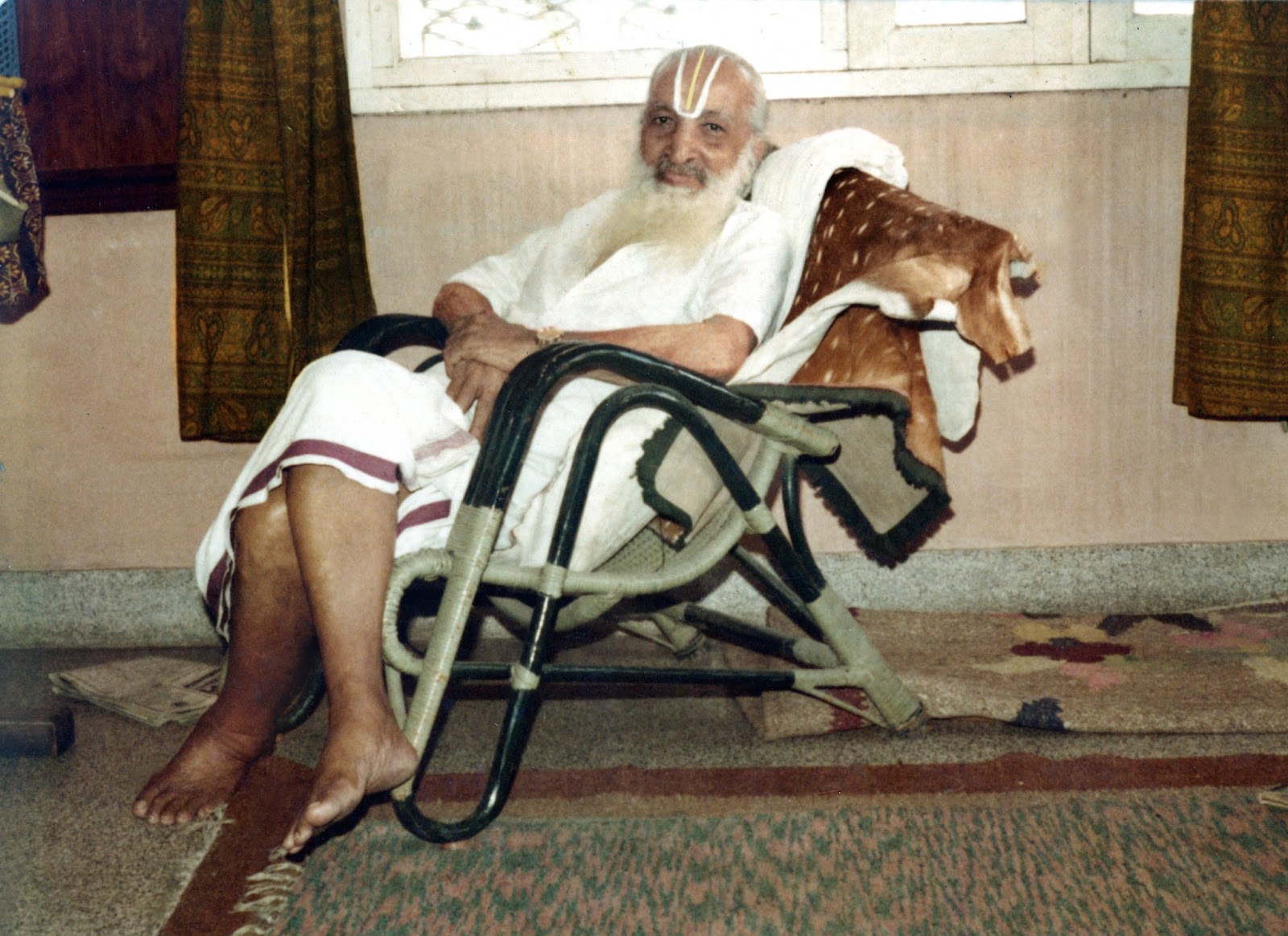
I think it was late 60s or early 70s. My guru was living with his family in Mandavelli, Madras. It was before he and his family moved into their own house in R K Puram later on. After a morning class I came out. I had with me my camera which I had taken with me as I was planning to go to a function and take pictures. As I came out I requested my guru if he would pose for a picture. His wife was just coming out from the kitchen. I requested her also if I could take a picture of both of them. Both agreed immediately and posed for this picture. I am sorry the print got spoilt somewhat. It is one of the rare pictures where you would see him with a suggestion of a smile. His wife, an extremely gracious lady, had a smile.


I graduated from college in 1960. I got a job in a termal power plant about 150 miles from Madras. I was reluctant to go. Sri Krishnamacharya was then coming to our house to teach my brother and others in the family. At the end of the class I told my Guru that I was going away to work in the thermal plant in Neiveli. Without a moment’s hesitation he turnd to my father and asked him why he could not find a job for me in Madras itself. I had not asked my father nor my father had offered to help me find a job in Madras. Then my father talked to a friend who was owning a motorcycle factory in the outskirts of the city and got me a job as a  trainee. They were manufacturing Enfield motorcycles. Without my guru’sgrace and intervention I would have lost the opportunity to study under him for long.

One day I did not attend the class in my house because of some  stomach ache. My Guru, as he was coming out of the class attended by others in my family, stopped and asked me how I was feeling and I mentioned to him that I was having stomach ache and that I could not attend the class. He asked me to lie down . He dug his firm fingers gently but deeply around the stomach muscles (rectus abdominus?) and gently pulled up the muscles a couple of times. Like magic the pain was gone, as perhaps because his procedure released the stomach cramps.

However it posed another problem.. I had to be at the factory at 7 AM which meant I had to  be at the bus stand by 6 AM. I could not go to classes in the evening as I would be home only by 7 PM and Sri Krishnamacharya was not teaching at that time after sunset. So I put the problem before my teacher and he gave a solution. He asked me and my father to be at his house at 5AM, and study for one hour so that I could get to the bus stand in time which was close by. I used to get up sufficiently early in the morning have my shower and be at his house with my father a 5AM. By that time he would have completed all his practice puja and everything and be ready to receive his first students for the day. He was so accommodative. This went on for one full year when I quit the job and attended his classes at more convenient hours. 


Paul Harvey was in Madras at that time for an extended stay (more than one year?) studying with Desikachar. Before leaving for UK, (I think with the tacit approval of Desikachar) he asked me if I would like to write briefly a booklet on Patanjali’s Yoga Sutra. I had just then completed writing in Indian Review a series of about 28 articles mostly on asanas. I wrote the booklet titled it as Basic tenets of Patanjala Yoga and sent it to Paul. After some time he  printed/published  it under “Cambridge Yoga Society” and sent a few copies. At that time I had taken a short break of a few weeks of my studies with my Guru as I had some compelling other works. The book arrived during that break. One summer afternoon as I was at home, my Guru Sri Krishnamacharya came to my house with Desikachar. He sat down on a straw mat and told me that he was very happy that I published a book and that he would like to me to write more books and that I would have his blessings. He looked genuinely pleased and I was overwhelmed with gratitude at this unexpected blessing. He left very soon but this episode would come to my mind very often. I do not know if he read the book or anyone read it to him. How many teachers would be pleased and show their happiness at the little steps taken by the students?


Krishnamacharya was teaching Hatayogapradiika. He was teaching the kumbhaka chapter  wherein mention of 80 times  (asiti) pranayama is mentioned. He explained that. Later I casually mentioned to Desikachar that doing 80 times pranayama was not possible and it was an exaggerated statement of Svatmarama. I used to do about 10 or 20 pranayamas in the class. Next class, my Guru said that we would spend the entire hour for doing 80 times pranayama. He sat with me and did 80 rounds of pranayama.  He sat with me and encouraged me to do the full limit of pranayama. Nowadays I teach pranayama and encourage interested participants to experience an extended practice of pranayama occasionally. An 85 year old man sitting in a yogic posture and doing 80 times of pranayama for one full hour would stimulate anyone to try to do the same. He was absolutely dedicated to teaching yoga.


Once the renowned Mahesh Yogi came to Madras and  gave a hugely popular talk on TM at Rajaji Hall in Madras. There was a very large crowd. My father took me for the program. Next morning when I met Desikachar I mentioned to him about what Mahesh Yogi talked. He quietly listened to me. Next morning when I went for my individual class with Krishnamacharya, he started the class as usual with a prayer. Then he looked at me and said to this effect. He indicated that he (Krishnamacharya) knows what I need and he would be willing to give/teach it to me. For my part(Ramaswami) I should not shop around and get confused in the process. It is an unnecessary effort on the part of the teacher to remove these confusions. I was touched by the concern he had for the student. He minced no words and I am grateful for his straight talk and a very valuable advice.

I was about ten when  my grandfather, by chanting the gayaatri mantra into my right ear, initiated me to the study of Vedas during my upanayanam. Sometime later I joined my father to study chanting of some portions of the Vedas ( yajur veda ) from a young teacher . He would come everyday at 5 AM (except the anadhyayana days like new moon day). He taught us to chant Arunam, rudram camakam the taittiriya Upanishad, the suktas. It went on for a few years. Later on when I was 15,  I started studying with Sri Krishnamacharya    mainly asanas. After several years one day Desikachar mentioned that he was going to learn Vedic chanting from his father and wanted to know  if I would like to join him in the chanting classes. I said yes but I was not sure how a Yoga teacher would teach Vedic chanting because all the yoga teachers I had known were physical instructors and Vedic chanting is usually taught by Sanskrit pandits who have learnt chanting. Sri Krishnamacharya with a booming voice and correct accent of the Sanskrit syllables and as per prescribed intonation taught several chapters of the Krishna Yajur veda. It went on for several years. After Arunam, taittiriya upanishad and the suktas, he taught almost the entire taittiriya aranyakam, the pravargya, pravargya brahmana, citti sruk, svadhyaya prakarana mahanarayana Upanishad, then the three chapters of taiitiriya kataka which forms the basis of the famous katopanishad,. Meanwhile I had learnt to chant the yoga sutras as part of the detailed study of YS with Sri Krishnamacharya.

I used to sit at home in our puja room and chant several of the chants I had learnt from my Guru. One day when I was chanting, a famous musician and her husband had come to my house to meet my father and as they were waiting they heard my chanting. Later they told my father that my chanting was very pleasant to hear (sraavya). I was encouraged by this and then bought my first tape recorder and recorded the YS. Once Desikachar had several students from the west and they wanted to meet my Guru. Sri Desikachar arranged a program wherein He and Krishnamacharya would do some Vedic chanting. Sri Krishnamacharya I guess suggested that I too should join and all the three of us could chant some Vedic passages together, I felt very honored and thought it was great way of my Guru to encourage me. All these made me  record the chant of the sutras in my new tape recorder. I thought since Yoga was getting popular I would chant this. I played it to a few of my father’s friends and they all seemed to like the voice and delivery. Then I approached a class mate of mine whose father was a famous film director and producer. I asked him if he would help me to have my chanting recorded by a recording company. He introduced me to HMV. The person in charge listened to the chant for an extended time and said it was good, very good, but the marketing people said that since I was an unknown entity it would be difficult to sell. Music is saleable but chanting, they were not sure. So the producer advised me to try to get some publicity like doing a few programs over All India Radio, the only radio network in India at that time.

The editor of the journal that  published my series of articles had known the director of All India Radio or Akashvani in Madras. I met him and he directed me to the program director of the Sanskrit program. The studio was broadcasting a 15 minute Sanskrit program every Tuesday night between 9;15 PM and 9:30 PM considered prime time immediately after the national news. TV in B&W was just then introduced and had not taken roots and owning an expensive TV set was a luxury. So people normally tuned to the radio for news entertainment concerts, talks etc. 

The program executive asked me to prepare a program and give the manuscript to him so that he would go through that and decide. I recorded the talk in my tape recorder which also contained the chanting of the first chapter of Yoga Sutras. I also gave a hard copy. He took his own sweet time and finally agreed to give just one program. The program was recorded in the studio and as I was coming out he asked me if I would like to do another program. I gleefully agreed and told my Guru about it. He blessed me and suggested a few topics for the next talk. Then I went on doing several programs for a few years and for every talk I would prepare and show it to my guru. The talks I gave included Story of Patanjali, Hatayoga pradipika, Vivaha mantras (wedding vows), Upanishad Kavyas and a number of others. For the Upanishad Kavyas my guru dictated a beautiful passage in Sanskrit which I included in the talk. He was completely supportive of these endeavors. His chanting was authentic. He gave importance to the six parameters of chanting, viz., varna (letter pronunciation), svara ( note), matra (time duration of each syllable) balam (right effort), sama (flow), Santana ( conjunction of words). Thanks to his teachings and blessings I was able to record about 20 titles of sanskrits chants between 1980 and 1995. These are made available as downloads (quite inexpensive) by the recording company ”Sangeetha Music” and about 35 hrs of chanting I reckon. These can be found in the following page of the catalogue of the company
http://www.sangeethamusic.com/shop/page/35/

The titles include Sundara Kandam of Ramayana (10hrs), Mukapanchasati (3hrs), Aswamedha (3 hrs), Devi Mahatmyam (3hrs), Anjaneya Sahasranama, Hariharaputra sahasranama, Raghavendra sahasranama, Vedasara Siva Sahasranama, Lalitha Sahasranama, Sandhyavandanam, Adityahrudayam and vedic chanting (Swadhyaya prakarana), Indrakshi sivakavacham with Vedic chanting (citti sruk), Taittiriya Upanishad, Mahanarayanopanishad, Bala Ramayana, Vishnu Sahasranama, Sri Ganesa Sahasranama, Sri Subrahmanya Sahasranama, Suryanamaskara and Yoga of Patanjali and Adi Sankara.

In addition another recording company released two more cds Durga Sahasranama and Gayatri Sahasranama.

I have written about some of these in my book. Well since many have not read my book some repetition may be pardoned. 

One afternoon when I went to see him for a class, he mentioned that J Krishnamurti who had come to Madras for his annual talks came to see him. He said that Krishnamurty was a complete Nasthika (atheist). Still he wanted my Guru to pour all the traditional yogic knowledge and experience to his principal student. My Guru said, “I am willing, I am willing to teach all my students, give without any reservation. But they should be able and willing to take (absorb) what I teach. There was a genuine interest in his voice about his personal commitment to teach the traditional wisdom and his own experience to the next generation so that they could transmit the knowledge to the next generation as per their ability and understanding. There was intense desire to teach and part with the vast traditional knowledge and experience he had acquired through hard and painstaking study and work. His krupa was always there for his students.


Srivatsa Ramaswami - Vinyasa krama

Newsletters