Friday, 27 July 2018

After Ashtanga (?)

I still get mail, there is clearly a lot of disillusionment in the Ashtanga community of late, from students and teachers alike. For some the spell has been broken somewhat and there is the temptation to let the practice lapse, to give it up altogether, but then what, what comes after Ashtanga. When a practice has dominated your life for months, years, decades even, what happens if and when you stop, there is some fear there, grief even for something lost, a practice, a lifestyle, a community.

"I still love the practice but....". 

I've been hearing that a lot.

'I love the practice but I don't want anything to do with Pattabhi Jois, or lately with Sharath, or with those friends and teachers I'd looked up to who criticised and vilified the victims of those who came forward to talk about Jois' abuse, as well as any who spoke up in support'.

Or indeed,

"...all those who stayed silent".

I'm sure I'm not the right person to comment, I've been moving further and further away from straight, by-the-book Ashtanga for years. And yet I always tended to feel that what I was practicing was somehow still Ashtanga, a couple of months ago however it did feel like a final clean break ( see previous post, 'No longer identifying as an Ashtagni').

I practiced Qigong for three months, I learned Tai chi, I practiced Simon Borg-Olivier's Spinal movements, asana virtually disappeared from my practice..... but then it came back. At first I would just include Krishnamacharya/Ramaswami's key asana but then I would move from Simon's spinal movements into some Standing postures and soon realised that I was basically practicing half Primary.

I've always felt that half Primary made a lovely practice ( half second perhaps every couple of days), being short it allows plenty of time for pranayama and a Sit just as Krishnamacharya intended. It's modifiable, you can practice it slowly, long slow breathing perhaps with kumbhaka following Krishnamacharya's instruction in his early Mysore text, 'Yoga Makaranda'. Or you could practice it with natural breathing as Simon Borg-Olivier might suggest along with his anatomical and physiological guidelines. You could add in a couple of preparatory postures or more advanced developments of a posture or both as we see in Ramaswami's Vinyasa Krama, also clearly present in Krishnamacharya's early teaching. Practiced this way we are perhaps recovering Krishnamachary's original Mysore teaching, we are in the Realm of Pre-Jois, pre-Ashtanga.

What is most important it seems is that we do still practice...  something, that we maintain a daily discipline to assist in giving focus to our lives in seeking to reduce our attachments, especially in this period of unease. Yoga Philosophy is very simple, it's the commentators who distort or make it complicated. I remember Ramaswami saying that he always found  Patanjali's Yoga Sutras approachable, immediate (my words), it's the commentaries that confuse matters.

We might practice other forms of exercise of course but as the Italians might say, Asana 'marries' with pranayama and Asana, they come from the same soil.

Pattabhi Jois lifted his Primary and Second series from Krishnamacharya's table of asana (which we find in Krishnamacharya second Mysore book, 'Yogasanagalu'). Jois' Primary series is barely changed from the table, minor tweaks. Jois' second series contains a little more of a shuffle, a rearrangement of some of Krishnamacharya's asana groups, the Advanced series, while containing the same asana as Krishnamacharya's table, is completely different following the requirements of the course Jois was asked to teach, as both Krishnamacharya said, Advanced asana is for demonstration.

Note: This is in no way an attempt to 'airbrush' Pattabhi Jois out the Ashtanga Vinyasa story, to do so would also airbrush out the victims of his abuse, rather, while recognising that Pattabhi Jois promoted aspects of his teacher Krishnamacharya's approach to Yoga we can perhaps move out of Jois' shadow and look directly to his source.

If the asana are the same, the way they have become practiced is not.

Fixed series perhaps helped make Ashtanga popular (and those early practitioners were attracted to the physicality of the practice as much as any spiritual suggestion), but popular is not necessarily better. Fixed series also caused problems, it introduced pitfalls. A fixed series led to faster breathing, a hot, faster sweaty practice as we seek to cram a whole series, or a series and a half, into our morning before running off to the office. A long fixed series meant that pranayama was basically discarded along the way. Meditation, the whole point of the practice for Krishnamacharya and indeed for Patanjali barely made it into the picture.

We became asana obsessed, fixated, our attachments grew perhaps rather than lessened.

Meanwhile, the money rolled in.... to Mysore, piles of it.

Practice asana as we wish and for whatever reason and watch how our practice and our reasons for practice change. Practice to escape, to break a patten, a habit. Practice for health and or fitness, practice for a beautiful body, practice as a hobby as a devotion, for a community all are of course perfectly justifiable but if we practice asana for Yoga, as Yoga, then we surely need to try and keep the asana in perspective and not lose ourselves in the asana at the expense of Yoga or mislead ourselves or others by the suggestion that asana is sufficient.

Sharath of course, however well intentioned he may have been, sought to preserve his grandfather's legacy. Despite being well aware of the sexual abuse committed by his grandfather Pattabhi Jois, even being present in the same practice spaces on occasions when it occurred, Sharath still virtually deifies his grandfather every Guru Purnima, Sharath's legitimacy is tied to his grandfather. Sharath took care of the family business, now no doubt he looks out for his own families future. Becoming ever more authoritarian and dogmatic  to this outside observer, the practice seems to have become, as it were, preserved in amber.


Most of the the shalas, studios and gyms have, I would argue, abandoned the essence of the practice, discarded the pranayama and the meditative activity, some though have rediscovered it, teach it quietly, somewhat under the radar, often unauthorised or de-authorised teachers the former perhaps never choosing to visit Mysore, the latter choosing not to return, both practice with the same devotion as those who make yearly visits to Mysore.

For Krishnamacharya the asana and pranayama clean the room, we don't then leave, we sit. Krishnamacharya suggested that the meditative activity be twice as long as the pranayama, the pranayama twice as long as the asana, asana is the lesser of the three and yet in Jois' Ashtanga it has eclipsed the other two

Note: Manju Jois, Pattabhi Jois' son still includes pranayama and a meditative activity (chanting) after every practice.

The growing disillusionment with Ashtanga is perhaps an opportunity to recover the Pre-Jois practice of Krishnamacharya. It is a simple practice, perhaps half a Jois Ashtanga series or a handful of basic postures practiced mindfully, with or without transitions followed by a simple breathing practice and a meditative activity. It's as fixed as we want it to be, as modifiable as we wish it to be. It perhaps recovers much that was lost along the way as Ashtanga was made more popular, more marketable.

We should perhaps ask ourselves more seriously, I should have asked myself more seriously....

"How fit is fit enough, how strong is strong enough, how flexible is flexible enough". 

Because one glance at Instagram is enough to show us that the ballerinas, the gymnasts the acrobats and contortionists, the martial artists all exceed our most 'liked' practitioners in terms of grace and flexibility, fitness, strength and application. We shouldn't kid ourselves with a "Yes but our practice is more authentic, traditional (it really isn't), more....meditative...., it's YOGA ", We discarded meditative and likely yoga along with it when we fixated on asana, on a sold system. We listening to those who trumpeted the system, defended it and justified it's popularised form. We should perhaps have listened to the voice inside that knew better all along that there was perhaps another way to approach the same practice.

Many practice their Ashtanga this way already, as Richard Freeman has said, those who are less flexible are somewhat blessed. Home practitioners are equally blessed. A different approach to our practice suits us at different times, I myself may have needed at the time, the full-on dynamic, sweaty asana/series chase for a time but perhaps I became somewhat lost in that. Most who stay in Ashtanga will no doubt end up adapting their practice eventually anyway, as they let go of the asana chase, the series chase, perhaps the fame chase.

How do we respond to the Ashtanga crisis? Reduce our attachments, we might start with the view of practice we have become attached to.

We are so often seeking legitimacy for our practice, authority. The authority for our practice, the legitimacy of however we practice comes from our Sitting, from how well our practice prepares us to Sit or to go through our lives mindfully and treading lightly.

Make shapes mindfully, breathe, sit and follow our yama/niyamas as best we can, enjoy our practice.


Note: The idea of practicing less asana (perhaps half rather than a full series) is to allow time for Pranayama and a Meditative activity, not to allow you to leave your mat early for cake...., as M. seems to think.

Sunday, 1 July 2018

Standing Asanas - Srivatsa Ramaswami July 2018 Newsletter

Standing Asanas

Even as the definition asana is to be seated, in Hatayoga several standing postures are common and popular. In the vinyasakra yoga practice out of the 10 major sequences three are standing sequences. The most well known is the Tadasana sequence wherein one stands with the feet together and performs several asanas and many vinyasas centered around individaul asanas subroutines. Of the other two sequences, one requies standing on one leg and keeping the other leg in different positions in different asanas and then doing exquisite movements standing on one leg.This sequence requires a great sense of balance and regular practice instils a certain sense of balance both physical and mental. The third sequence in standing  with the feet apart say equl to the length of one's leg, in the form of a triangle,known as trikonasana. This sequence is very popular with contemporary yogis. Because of the broader base Trikonasana affords,it becomes much easier to work powerfully with the body muscles and also work with the joints as hips spine etc. 

The Tadasana sequence is the first asana sequence my Guru taught us. Standing on both the feet with the feet together, ankles touching each other, the thighs close, pelvis slightly forward and shoulders slightly thrown back this ensures standing straight in samasthiti or state of balance. Keeping the head down one mey watch how one balances when the eyes are also closed. Staying for a minute or two daily as soon as one gets up from bed would help to start the day with an even temperament. Since all movements are done with synchronized breathing in  this system, a minute or two of close observance of the breath would be helpful. Then many arm movements known as hasta or bhuja vinyasas help to stretch the muscles of the arms, neck and the chest and thus the accessory muscles of breathing. This would facilitate good breathing habits. Parva Bhangi and the vinyasas of side bending and also sideward turning  both of which will help the flexibility of the spine and forms the next subroutine in this Tadasana major sequence. Forward bending or uttanasana is the next subroutine and can be done with ardha uttanasana or half forward bending. This early prparation helps to stetch the muscles in the posterior part of the body as the calf muscces, the thigh muscles, the hamstrings, the glutial muscles etc. This subroutine lends itself to several vinyasas of the arms like padangushtasana, niralamba uttanasana. parsva- bhaga uttanasana and others. The next major joints that are dealt with are he knees,and all these are done still with the feet kept together and doing all contraction movements on exhalation synchronized with the movements and expansion movements like back bending during inhalation. Half squat and then full squat with varying arm positions mark the variety of vinyasas in this sequence. Utkatasana also can be used for some more involved asanas like malasana, kanchyasana, pasasana and others. Finally we have the tadasana where one tends to stand on the toes. It could be seen that vinyasa krama provides opportunities to do several asanas subroutines and vinyasas to be performed within  one basic asana in this case the Tadasana. There are a few very interesting off shoots from this sequence viz., Khagasana or bird pose, ding namaskara or salutation to the directions and with some additions from other asanas the well known surya namaskara the 12 vinyasa subsequence to salute the sun.

One legged postures are a class. When these postures are approached with vinyasas they bring out the best of balance. These were aso known as tapasvin poses or penance poses. Asanas like Bhagiratasana, Durvasasana and trivikramasana named after an avatara of the Lord, Vishnu come to mind. Though these poses appear simple if one can learn to stay in these poses for a time, say five minutes or more then one develops a good sense of balance a certin calmness and which will be helpful in developing one pointedness. Many of those who participate in the vinyasa krama yoga program initially do not consider them as very exciting but over a period of time start appreciating the unique sense of balance and calm they appear tpo generate and include them in their daily cup of asanas.popular with modern day yogis.

The Trikonasana or Triangle pose is very popular with modern yogis The uttita trikonasana where the feet are kept wide apart, usually involves side bending without bending the knees and looking straight. These are very good hip exercises and because of the broad base one is able to stretch the muscles more powerfully. The next asana and vinyasas will be uttita parva konasana wherein one still standing straight with the feet kept apart but bends the knees alternately to bend on either side. This lateral movement of the hips on a firm base of the feet helps to slowly and strongly stretch the hips, the groin and perineum laterally. Then we have the parsvottanasana wherein one turns to sides alternately with the feet kept aprt as in trikonasana. Without bending the knees one would bed forward giving a powerful turn to the hips. And finally we have the famous virabahadrasana or better known as warrior pose wherein one not only turns the body to the side but also bends one of the knees giving a new set of movements strong and powerful. There are quite a few vinyasa movements possible in each one of the four asana positions with the Trikonasana base.

The next set of asanas while  standing can be considered an extension of trikonasana wherein one spreads the feet further apart and do a few movements like forward bends side bends and also some back bends. It is known as prasarita pada uttanasana.If one can spread the legs further one can sit on the floor which would be samakonasana.a
The three major standing sequences with a number of subroutines and scores of breath synchronized winyasas are very powerful and may be an artistic way of doing asana practice afforded by Vinyasa krama. For more instructions and movemnts please refer to my book "Complete Book of Vinyasa Yoga"


***

I am sending this letter a couple of days earlier than usual as I will be travelling next couple of days and may not have adequate facility to send it later


--------
Steven Ross attended my 6 week full time  200 hour  Vinyasakrama Yoga Teacher Training program at Loyola Marymount University several years back. Since then he started a yoga studio in Austin TX, East Side Yoga and has run it successfully for sevaral years now. I taught a week long program there a few years back and was in his Studio again earlier this month for a week. For the weekend I spoke on Mantra yoga, taught Vinyasakrama and also spoke and taught Viloma Ujjayi pranayama. During the week, I taught in the forenoon several sequences from Vinyasakrama yoga based on my studies with my Guru Sri Krishnamacharya. It included Tadasana (tree or mountain pose and vinyasas), Asymmetric seated poses like marychyasana, Janusirshsana and vinyasas, Trikonasana sequence including Virabhadtasana and vinyasas, Suptasana including sarvangasana and vinyasas, Vajrasana and other seated poses and vinyasas and pranayama and introduction to dharana meditation practice. The afternoon sessions each 2 1/2 hrs included discussion of several topics of interest to practising yogis like 1) what is Yoga 2) Hatayoga for Internal Organs, 3) Fundamentals of Samkhya 4) The first 4 sutras of Yoga sutra 5) Upanishad Vidyas. Nice group and very good participation. Thank you Steven and all those who participated.


I will be teaching a 15 day 100 hr Vinyasakrama Yoga TT program at One Yoga in Victoria Canada from June 30th 2018

 I would like to mention about another program that yoga practitioners and teachers may find especially useful. It will be for 8 days teaching, morning 2hrs 30 mts  Samkhya Karika and afternoon 2hrs 30 mts the close sibling philosophy (darsana) Yoga Sutras of Patanjali, totalling 20 hrs each. Studying these two darsanas that complement each other could be very useful in understanding the Sutras better. The twin program starts July 28, 2018 Here is the link to register

https://cal.lmu.edu/event/lmux180728#.WzEVWKczaM-

Monday, 4 June 2018

No longer identifying as an Ashtangi..... or a 'yogi' for that matter.

I saw this expression recently  'I no longer identify as...', it's not ideal perhaps but it struck a chord, it seemed a convenient way to encapsulate my thinking (feeling?) of late and certainly as a conceit in trying to write this difficult post.


"I no longer identify as an Ashtangi".

Update: Somebody just commented "Who cares". They make a good point, but after eleven years of daily practice and ten of writing about it, feeling that I (and I'm assuming I'm no alone) no longer want to be identified with this practice.... well, I care, clearly.

Practicing Qigong by Lake Biwa. I have this lake two minutes from my door,
can't help wanting to make the most of it.

Identifying as anything is probably not a good idea in the first place but it's easily done and more often than not just convenient, especially when writing a blog.

From early on I seemed to have identified my daily practice as Ashtanga, and as we so often end up fitting our life around our practice we end up identifying ourselves by said practice. I don't think I ever identified as 'a yogi' however.

Those who run each morning, whose diet changes on account of their running, who go to bed early because they know they will be getting up early the next morning to run, who become fascinated by the technique of running and read all they can as well as at some point any anatomy that relates to the occasional aches and pains they develop. They no doubt end up with friends with similar interests, the only people perhaps who can understand a commitment to a practice that seems to feed into all areas of their lives. They too no doubt often identify themselves with their practice, as 'a runner'.

Though I didn't perhaps follow the expected or indicated path of practicing at shalas and going to Mysore, preferring to practice at home alone, I still seem to have ended up identifying myself as an Ashtangi, a home Ashtangi perhaps but an Ashtangi all the same.

As the years went on and I explored and practiced with Ramaswami and looked more deeply into that which Krishnamacharya shared with him, I still considered my practice Ashtanga. My Vinyasa Krama would fall naturally into the shape and format of the Ashtanga practice I was most familiar with. Likewise, when I went back to Krishnamacharya's own early Mysore texts and practiced for a couple of years as he indicated in his texts it was still, in my mind, Ashtanga. We could see the table of asana in Krishnamacharya's Yogasanagalu (Mysore 1941)  that, with minor modification, became Jois' presentation of his teacher's practice, it was all essentially Krishnamacharya's practice, somewhat simplified perhaps in Jois but essentially the same, the philosophy was the same, the goal supposedly the same.

This year I have moved further away from straight ashtanga than ever before. I would start my practice with some of Simon Borg-Olivier's spinal movements, do a few standing postures then four or five seated asana before moving into shoulder stand and headstand sequences (Note: Jois indicated in Yoga Mala that we would/could/should adapt our practice after reaching 50). Most Ashtangi's wouldn't perhaps have recognised it as Ashtanga but to my mind it was still essentially Ashtanga. If I had thought about it I probably still identified as 'an Ashtangi'.

So what changed.

A month ago I stopped practicing asana, Simon Borg-Olivier's Spinal movements no longer led into standing and seated asana but into other Qigong sets and exercises, the sets came together into a practice. I liked that I could do my whole practice standing up and that I could stroll down to the lake and practice beside it, just as I was, without a mat or thinking too much about what I happened to be wearing. I liked that I wasn't binding, laying on my back, standing on my head. I liked that I could do my meditation practice standing as well as my active practice. I liked how my practice became somewhat more of a part of the nature I have surrounded myself with here ,between the lake and the mountains. I liked the way my body felt, alive from toe to crown, energised rather than physically tired.

Ashtangi's will often tend to suggest that those who leave Ashtanga couldn't handle the boredom or the physicality of the practice. I can honestly say that I don't remember a single practice in which I felt the slightest bit bored. I loved the physicality of the practice too. In the early days, the sweat and exhaustion was exhilarating but latter too when I would practice more slowly with calmer, slower breathing in a cooler room I loved the physicality of that too.

I still believe Ashtanga is a delightful practice. Practiced well, mindfully, humbly...., modestly it can be a wonderful way to build discipline and focus, especially if these are something one has always struggled with. The naysayers of Ashtanga often have an extreme form of how it is occasionally, unfortunately, taught and practiced. Taught and practiced mindfully it's fine.

So why....

Well you know why or can perhaps guess.

I have written here that all that has gone on concerning Pattabhi Jois' historic sexual abuse need not concern our practice and I still stand by that. Besides, Krishnamacharya has been more of a focus for me in my practice than Pattabhi Jois. Not going to a Shala daily, not practicing regularly with a teacher who practiced with Jois directly. Not going to Mysore, the Jois family has been of less concern or interest than it might have been. I did though go to Manju to try and get an idea of how Jois taught his son before the western students came, to try and get as close to Jois' time with Krishnamacharya as I could. I went back to Manju though because I loved him not because of whose son he was. Sharath has always been somewhat of a disappointment from afar. His was always a difficult gig, taking over from his grandfather as he chose to do, but if the Paramaguru title wasn't the last straw for me then his treatment of others during the teacher's list debacle certainly was. Perhaps if I had practiced with him directly I would be more.... tolerant, kinder.

Jois' abuse is in the past, or at least it is for those of us who luckily never suffered it directly, but the response to that abuse is of the present. It is NOW. Still people turn away, make excuses, dismiss or vilify those brave enough to speak up at last. Some of my own friends and loved ones still post photos of a smiling Jois while those who can't hep but re-live aspects of the trauma they experienced through speaking up are revealing their scars. Videos that include, as we can clearly see now, Jois abusing others, not as explicitly perhaps as in some other videos but still there to see, are still being pointedly shared on social media. I find it shameful and have quite frankly wanted nothing to do with the practice or community, wash my hands on the whole thing.

Nobody is damaging Jois' reputation, he did that himself through his behaviour.

We saw the photos and made excuses
We heard testimony but didn't listen.
Finally one of the most widely respected teacher in our community spoke up.
Victims/sufferers broke silence.
We heard reports that Sharath and Saraswati saw the abuse themselves and tried to stop  it.
We read more direct testimony from those who were also abused.
We heard from other respected teachers what they had themselves seen, we heard the shame they expressed in not speaking up, in not doing more.
We read a brief apology, later disappointingly deleted, from Jois' own Son.

See this post for details http://grimmly2007.blogspot.com/2017/12/inappropriate-adjustments.html

And still there are those making excuses, looking the other way, vilifying, and STILL posting smiling photos of Jois along with videos of his abusive teaching.

It's not the past that made me want to unidentify myself with Ashtanga, it is the present.

Kino/Alo/Cody is just one more disappointing sideshow.

I didn't intend to write so strongly, triggers.

And yet......

And yet M. still practices her Primary, there beside my Qigong on the weekend. And I stumble upon photos and videos of Ashtangi's practicing, photos and videos that are about the practice itself rather than about them personally, unlike so many other photos and videos on social media. I choose to believe that most have a sincere relationship with the practice, that it's not about looking good though perhaps feeling good, that it's about the work, the discipline and focus, that there is a sincerity in this practice. I know that there several teachers who seek fame, recognition, monetary rewards but again, I choose to believe that most teachers are rarely heard about outside their own circle and put themselves there at the service of their students. Many may perhaps be too strongly influenced by Sharath and have a heavy hand in their teaching but the hope is that the more they teach the lighter their hand will become.

It was for this reason, this more hopeful feeling and resilient fondness for the practice that I brought my Manduka back out of the cupboard and practiced Primary along with M. on Saturday and am planning to practice once a week beside her.

And it was a delightful practice. I was surprised that I could still bind Marichi D and Supta kurmasana, Qigong seems to be maintaining some flexibility at least. However, if Ashtanga is often thought to be about upper body strength then qigong is about the legs, I'd lost a lot of strength in my shoulders and across my chest, chaturanga and upward facing dog were killing me by the end of the practice. I also found my hamstrings were a lot tighter and I had almost lost Urdhva Dhanurasana altogether. At the end, after a little pranayama and a short Sit, I was reminded why I fell in love with this practice in the first place.

Will I go back to it? Perhaps one day if/when I lose this taste in my mouth.

Note: Current practice here.
http://activemovementyogaathome.blogspot.com/2018/07/current-practice.html


I notice that I'm coming up to ten years blogging about Ashtanga, July 9th 2008 was my first post, it was on Jumping back when this blog was still called Ashtanga Jump back.... at Home.


FIN


Friday, 1 June 2018

Upanishad Vidyas - June 2018 Newsletter from Srivatsa Ramaswami-

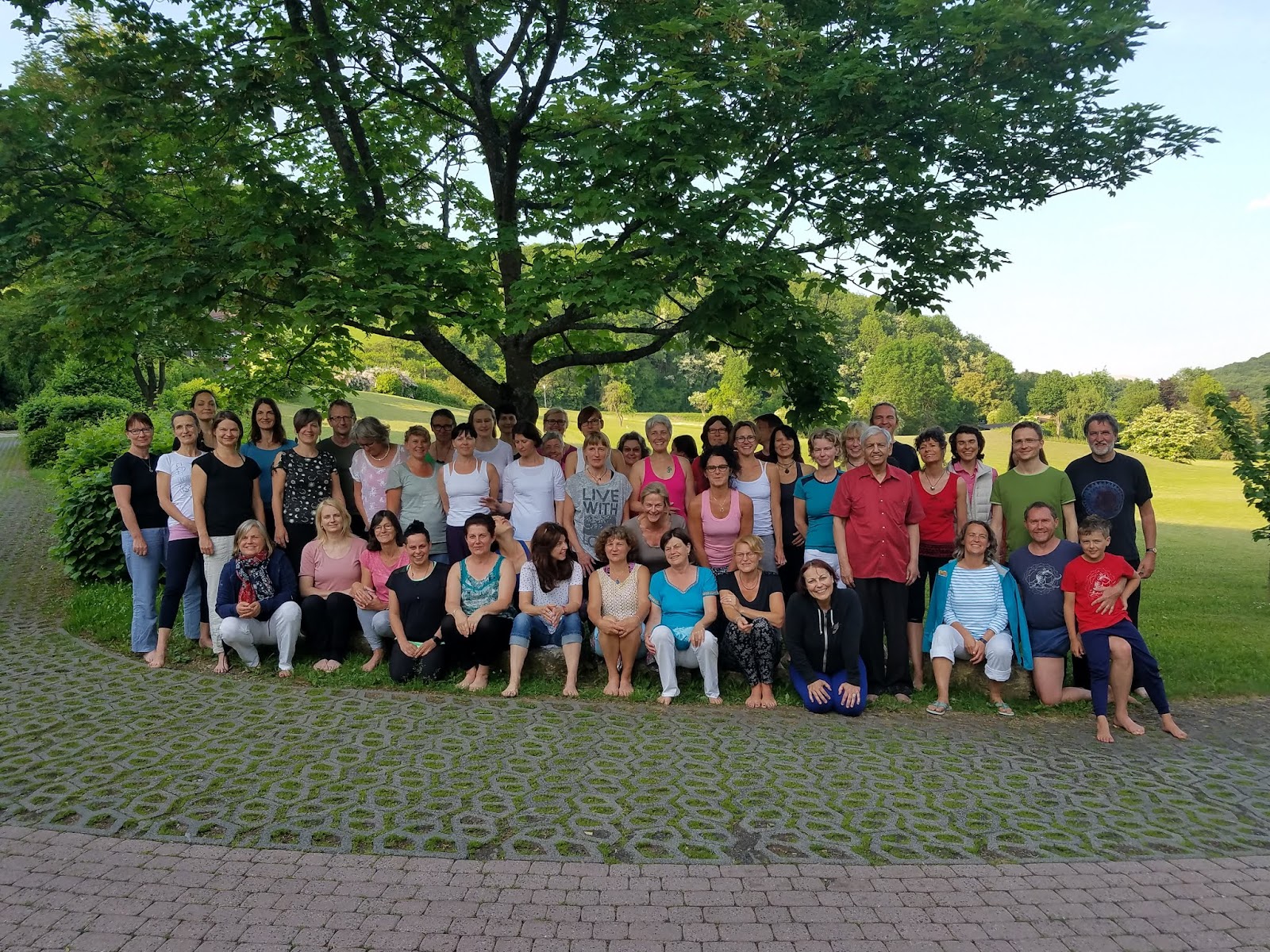
I was for three days in Germany teaching a workshop on yoga.The program was organized by BDY (German Yoga Body)( my translation). About 50 yoga teachers and practitioners attended the program.
On pranayama I had indicated that exhalation or racaka is perhaps the most important factor in learning pranyama practice. With a thorough exhalation making use ot the rectal, pelvic abdominal muscles and a flexible strong diaphragm the yogi is able to achieve exceptional racaka. And this facilitates a very good inhalation next taking in considerable fresh air. A few times say about 40 such pranayama everyday is refreshing as it helps to remove stale air from the lungs and take in fresh oxygen. My Guru would day that with recaka bala or strength of recaka or exhalation a hatayogi achieves a lot.

The whole program was arranged by my 20 year long friend Klaus Koenig.He translated the talks, demonstrated many postures. His young son 9 year old Hagen also was there helping his hard working father. A lovely kid.

On the way to the airport, Hagen gave a 'riddle'. How do you get a cow into a refrigerator? I could not imagine a cow in a  refrigerator like the one in my house. I said I did not know. He said, just open the door and put the cow in and close the door . Oh yes if the refrigerator was large enough it could hold the cow. Then he went on and asked, "Now, how can get a horse into the same refrigerator. I thought I knew the answer and said "Open the door, put the horse in the refrigerator and close the door"?He smiled and said, "No, you first get the cow out of the refrigerator and then put the horse in".

Klause continued. In the same way you exhale completely and then inhale for pranayama. Remove the stale air (cow) with recaka from the lungs (refrigerator) and then fill the lungs (refrigerator) with good inhalation or puraka(the horse)


In June I will be teaching a weeklong program covering a variety of yoga related topics at East Side Yoga in Austin Texas. Here is the link for more information

http://www.eastsideyoga-austin.com/product/srivatsa-ramaswami-visit-june-2018/

From June 30th to mid July I am scheduled to teach a 15 day 100 hour Vinyasakrama yoga teacher training program at One yoga in Victoria, Canada. Though I had not planned any more of this TT program, because my last year scheduled program at Oneyoga at Montreal was cancelled, we agreed to do it in Victoria for Oneyoga of my friend Ryan Leir. It will have three components A sixty hour segment will cover more than 700 vinyasas centered around more than 120 classical asanas in 10 major sequences,following the Vinyasakrama methodology with breath orientation as taught by my Guru Sri Krishnamacharya. Then there will be 20 hour segment consisting of a variety of pranayama methods and practice of some important pranayama procedures. It will also include the bandhas. In addition we will also cover yogic procedures that have a direct bearing upon the health of six internal organs or koshas viz., the heart and the circulatory system, the lungs and the respiratory system, the stomach and the digestive system, the kidneys/bladder and the urinary system, the intestines  and the uterus and  the reproductive systems. The third component  will be for 20 hours in which we will go through all the sutras in the fourt chapters of Patanjali's yoga sutra.

I understand that there are still a few spots available even as the registration so far has been good. Here is the link.

http://oneyogavictoria.com/events/vinyasa-krama-teacher-training-with-srivatsa-ramaswami


Of course I should also mention about another important program I will be doing at Loyola Marymount University in July/August 2018. It will be 8 day program of yoga related text studies. I will be teaching the twin darsanas or philosophies of Samkhya and Yoga one in the morning and one in the afternoon. We will go throug all the 72 slokas or verses of Samkhya Karika of Iswarakrishna and then in the afternoon all the sutras of Patanjali. Since these texts complement each other it will be very useful to study them together. Here is the link for registration.
https://academics.lmu.edu/extension/crs/yoga/programs/vinyasa/

http://www.vinyasakrama.com/Events

Upanishad Vidyas

(Photo is my addition to the newsletter - Grimmly)

Sri Krishnamacharya after teaching in detail both Samkhya Karika and Yoga Sutras started teaching several upanishads and upanishad vidyas. One day I asked my Guru why there are so many upanishads and upanishad vidyas if they all have one goal of teaching one Truth principle called the Brahman. He replied that since there are several teachers and students with different abilities it would be necessary to adopt different methods, discussions and arguments to arrive at the same Truth. Here I will take up a few such Vidyas and how they help the reader to understand the nature of Brahman

Perhaps  the most studied upanishad is Mandukya Upanishad wherein the Rishi author endeavours to explain that reality through our daily experiential states of waking dreaming and deep sleep to arrive at the fourth state of Brahmanhood.  The Vedas refer to that ultimate reality by the pranava mantra “OM” which is made of  the vowels 'a'. 'u'. and  the consonant 'm'  and It represents the three states we experience daily. We all agree that each one of us experience these three states daily. But are we able to identify this entity that goes through, experiences all these states. That is what this upanishad does.

We usually say that  an individual acts  during the waking state, then lies down and has a dream and then deep sleep before waking up again to go through activities in the waking state. But what exactly is the nature of the individual who goes through all  the three stages? What are the differences among the three states and what is common in all the states? What is common in all the states is the Self and what is experienced in each state because they vary will not be the self. So the Upanishad identifies the waking state observer as pure consciousness or Brahman which is known as Atman at the individual level and is represented by the syllable 'a' of the pranava. Then the same atman is experiencing the dream state and is represented as 'u' and then deep sleep as 'm'.

Am I, Ramaswami.  not the one who has experience of waking state and then I lie down and have a dream and then deep sleep? There is a big difference. In waking state Ramaswami is the person identified commonly as the subject. But in dream we have another world the dream world, the dream objects. We all agree that the dream world and dream objects are different from the waking state world and objects and persons. In addition it is easy to see that the waking state subject Ramaswami is different from the dream state subject which the mind identifies as the subject which looks and acts differently from the waking state individual. It is also said that when one has a dream there is a partial temporary paralysis of several motor functions  and so the dreamer does not walk when the dream self does all activities. So the upanishad indicates that what we commonly talk about as the subject during waking state, it is different from the the subject in the dream state and the waking state dreamer is not the one who experiences the dream but the unvarying consciousness or Atman which is none other than Brahman. The upanishad wants us to see that the waking state Ramaswami is also an object for the Atman as the outside world and objects. Likewise for the Atman --and not Ramaswami-- the dream objects, the dream world and the dream self are all objects for the dream watching Atman identified by the Upanishad as 'u'. And one can extend the arguments to the deep sleep state as well. Then there is the pure state of the Atman/Brahman consciousness which yogis and liberated vedantins are said to be in, called kaivalya or brahma nirvana or the fourth state or turiya represented by the complete syllable 'AUM'

The Taittiriya upanishad looks at the ‘seen person’ as one made up of
five kosas, and exhorts the spiritual seeker to transcend the ‘five
kosa seen person’ by deep step by step contemplation and understand
the nature of the atman. These five kosas are envisaged, each one of
them as made up of the five parts of a bird,  and each one of the
kosas more subtle than the outer one. The five kosas start with the
one made of food or matter, the physical body. It is made of physical
matter  consisting of five distinct portions as the head, the right
and left wings, the body of the front and the tail or the back. It
gets energy from anna or food/matter. This kosa should be kept pure
and yogasanas are said to help one achieve this goal. There is a vedic
prayer which helps one pray for the pure satvic quality of the
physical body made fully of anna(annamaya) or matter.

This physical body is identified by everybody, including a child, as
the person, the self. But the self by definition is the innermost,
subtlest principle in every human being. Is there anything more subtle
than the physical body?  The upanishad begins to investigate.

And it finds out that there is an inner self to the physical body made
fully of life force called prana, in the same mold of the physical
body. This pranamaya permeates the whole physical body and is
visualized as the self of the physical body or annamaya kosa. It also
is visualized with five distinct parts, the head, the two wings, the
chest and then the tail. The Prana, the main life force is the head
of  vyana and apana are the right and left wings, then udana is the
body or heart of this kosa and then samana is the tail or support of
this system. A regular pranayama workout will help maintain this kosa
in good stead.

There is an inner self, of the shape of the person, to this prana maya
kosa which itself is a sheath or a kosa called mano maya. It is
permeated with an aspect of the chitta called manas. Manas coordinates
all the senses and instruments of action. Interestingly the most
important sense for a vedic scholar is the sense of hearing. Hearing
the vedas from the teacher the vedic student learns by heart the
vedas. Also this vedic student has his mano maya kosa full of vedic
knowledge. The head of this mano maya  is the yajur veda, the right
and the left wings are the rik and sama vedas. The body or the chest
is the vedic injunctions (adesa or the brahmana portion) and the tail
is the last veda, the atharva veda. It therefore actually refers to
our entire memory kosa. This kosa according to yogis can be kept in
good condition by pratyahara. The vaidics would say chanting of the
vedas  keeps the manomaya kosa in good shape.

Is there anything subtler than this? Yes, says the Upanishad. Subtler
than the mano maya is the vigyana maya or the kosa of intellect. This
is the self of the previous kosa, of the human form but is visualized
with a head which is shraddha or faith(in the scriptures). Since the
vedic scholar is doing this self analysis and investigation, he uses
this kosa towards the spiritual end. So the right wing is
righteousness or straight forwardness(rtam) and the left wing is satya
or the ultimate spiritual Truth. Then the heart or the atma of this
sheath is yoga or the ability to remain concentrated or go into
samadhi. The whole kosa is supported by mahat or universal
intelligence. The upanishad sadhaka has to have this kosa in good
stead to clearly understand the nature of the self using this kosa
diligently. And dhyana or meditation is the means of keeping this kosa
unpolluted.

The soul of this kosa is another subtle kosa called ananda maya which
is translated roughly as the bliss kosa. Again this kosa is  in the
human form but is visualized as a bird. The head of this kosa is
affection (priya), the right wing is glee (moda), the left wing is
ecstasy (pramoda) and the heart is bliss (ananda) and the support of
this is Brahman, the ultimate reality. The ultimate reality, the Atman/
Brahman which is defined (swarupa lakshana) as pure consciousness
unaffected by either time or space (satyam, gnanam anantam brahma) and
whose realization is possible by the path shown (tatasta lakshana) by
the knowledge called the pancha maya (kosa) vidya is what is to be
known to end the evil of transmigratory existence.

The first step is to  consider the human body, called the annamaya, as
part of the outside matter of the universe as it is that which is made
up of five elements, earth, water, etc., returns to the earth/universe
after death. During the lifetime, the annamaya body is sustained by
anna or food/matter, itself drawing the energy from it. The subtle
self of the human body which is the inner sheath known as pranamaya is
the one that keeps the body alive. The force that maintains it is
called prana sakti. It is said that udana, one of the five forces
keeps the balance between prana the inward life force and apana the
outward life force under balance. Once the udana loses that control at
the time of death, the apana with  prana and  other life forces leaves
the body. The other three sheaths , the manomaya, its inner core/
atman, the vigyana maya and the subtlest sheath the ananda maya are
controlled by the power of veil or ignorance called the avarana
sakthi. This is the power which prevents the individual from realizing
the true nature of one’s core or atman which is pure consciousness and
beyond the five kosas. This power when it operates in the subtlest or
the ananda maya kosa is known as ichha sakti or the power of desire.
When it operates in the vignyana maya kosa it is known as gnana sakti
or power of discrimination and then when it operates in the mano maya
it is known as kriya sakti. The desire for the desirable object arising
in the ananda maya leads the vignyana maya to contemplate the means
for fulfilling it and thereafter the manomaya directs the physical
body to do the necessary physical work to achieve the goal, which it
succeeds in sometimes and not some other times leading to the feeling
of happiness or unhappiness in the ananda maya self. Thus even though
the spiritual nature of the self is clearly discernible from the
pancha maya vidya of the Upanishads, it is obscured by the power of
the avarana sakthi or the power of spiritual ignorance which gets more
and more strengthened by the operation of this sakthi, life after
life. Hence the upanishad not only explains the nature of the real
self as opposed to the mistaken self (mithya atma) made up of five
kosas but also gives a step by step approach to strengthen the
spiritual knowledge leading to transcending the evil of endless
transmigratory existence.

Since the human body returns to earth and other elements the entire
universe including the human body is considered one virat one whole
universe of anna or matter of  the five elements. The prana which is
the subtle self of the human body is considered the subtle self
therefore of the universe and then regressing further one arrives at
the individual soul or atman as the self. And since now it is also the
Self of the Universe it is called Brahman and the advaitins proclaims
the oneness (advaita) of the individual self (atman) and the supreme
self (brahman) as one and the same. This pancha kosa vidya episode
I am reproducing from an earlier newsletter.

Once a seeker is able to directly experience the Brahman the seeker's happiness is immeasurable. This is described beautifully in the anandamaya vidya of the taittiriya upanishad.The Bliss of one good youth well versed in the Vedas, firm, strong, healthy, quick, to whom the whole earth with all its wealth belongs, is one kind of bliss. Hundredfold and hundredfold greater in bliss in the order of succession are the states of Manushya-Gandharvas, Deva-Gandharvas, Pitris, Ajnanaja-Devas, Karma-Devas, Devas, Indra, Brihaspati, Prajapati, Brahma.

The bliss of Brahman is not to be considered as equal to a result mathematically arrived at by multiplying human joy by many hundred folds but it is the Bliss that is indescribable and infinite, the eternal the only existence. Every time it is asserted that the Veda-knower enjoys all these degrees of Bliss pro­vided he is untainted by desire and passion. A person who realizes the Brahman also knows that the individual atman or purusha in each individual creature and the one in the Sun yonder are one and the same. Such an individual never returns to be born again after leaving the layered body.

There are many such vidyas that the variety of upanishads boast of. Satvidya, pratardana vidya, panchagni vidya, dahara vidya, sandilya vidya, upakosala vidya, pratardana vidya are some of them.  The Bhagavatgita refers to the atman/brahman as the constant witness of the experiences of the childhood, then adulthood and old age and even death. The Mandukya refers to the same atma/brahman as the unvarying witness of the waking state, dream state and the deep sleep experiences of daily life and then the state of moksha or the transcendental state, the fourth or turiya. The panchagni vidya of Brihadarnyaka upanishad explains the state of five transformation the atman witnesses that take place in an individual between death and being reborn as a member of another species

Wish you Happy reading of Upanishad Vidyas

Srivatsa Ramaswami

Upanishad Vidyas - Srivatsa Ramaswami June 2018 Newsletter from

Upanishad Vidyas

Sri Krishnamacharya after teaching in detail both Samkhya Karika and Yoga Sutras started teaching several upanishads and upanishad vidyas. One day I asked my Guru why there are so many upanishads and upanishad vidyas if they all have one goal of teaching one Truth principle called the Brahman. He replied that since there are several teachers and students with different abilities it would be necessary to adopt different methods, discussions and arguments to arrive at the same Truth. Here I will take up a few such Vidyas and how they help the reader to understand the nature of Brahman

Perhaps  the most studied upanishad is Mandukya Upanishad wherein the Rishi author endeavours to explain that reality through our daily experiential states of waking dreaming and deep sleep to arrive at the fourth state of Brahmanhood.  The Vedas refer to that ultimate reality by the pranava mantra “OM” which is made of  the vowels 'a'. 'u'. and  the consonant 'm'  and It represents the three states we experience daily. We all agree that each one of us experience these three states daily. But are we able to identify this entity that goes through, experiences all these states. That is what this upanishad does.

We usually say that  an individual acts  during the waking state, then lies down and has a dream and then deep sleep before waking up again to go through activities in the waking state. But what exactly is the nature of the individual who goes through all  the three stages? What are the differences among the three states and what is common in all the states? What is common in all the states is the Self and what is experienced in each state because they vary will not be the self. So the Upanishad identifies the waking state observer as pure consciousness or Brahman which is known as Atman at the individual level and is represented by the syllable 'a' of the pranava. Then the same atman is experiencing the dream state and is represented as 'u' and then deep sleep as 'm'. 

Am I, Ramaswami.  not the one who has experience of waking state and then I lie down and have a dream and then deep sleep? There is a big difference. In waking state Ramaswami is the person identified commonly as the subject. But in dream we have another world the dream world, the dream objects. We all agree that the dream world and dream objects are different from the waking state world and objects and persons. In addition it is easy to see that the waking state subject Ramaswami is different from the dream state subject which the mind identifies as the subject which looks and acts differently from the waking state individual. It is also said that when one has a dream there is a partial temporary paralysis of several motor functions  and so the dreamer does not walk when the dream self does all activities. So the upanishad indicates that what we commonly talk about as the subject during waking state, it is different from the the subject in the dream state and the waking state dreamer is not the one who experiences the dream but the unvarying consciousness or Atman which is none other than Brahman. The upanishad wants us to see that the waking state Ramaswami is also an object for the Atman as the outside world and objects. Likewise for the Atman --and not Ramaswami-- the dream objects, the dream world and the dream self are all objects for the dream watching Atman identified by the Upanishad as 'u'. And one can extend the arguments to the deep sleep state as well. Then there is the pure state of the Atman/Brahman consciousness which yogis and liberated vedantins are said to be in, called kaivalya or brahma nirvana or the fourth state or turiya represented by the complete syllable 'AUM'

The Taittiriya upanishad looks at the ‘seen person’ as one made up of
five kosas, and exhorts the spiritual seeker to transcend the ‘five
kosa seen person’ by deep step by step contemplation and understand
the nature of the atman. These five kosas are envisaged, each one of
them as made up of the five parts of a bird,  and each one of the
kosas more subtle than the outer one. The five kosas start with the
one made of food or matter, the physical body. It is made of physical
matter  consisting of five distinct portions as the head, the right
and left wings, the body of the front and the tail or the back. It
gets energy from anna or food/matter. This kosa should be kept pure
and yogasanas are said to help one achieve this goal. There is a vedic
prayer which helps one pray for the pure satvic quality of the
physical body made fully of anna(annamaya) or matter.

This physical body is identified by everybody, including a child, as
the person, the self. But the self by definition is the innermost,
subtlest principle in every human being. Is there anything more subtle
than the physical body?  The upanishad begins to investigate.

And it finds out that there is an inner self to the physical body made
fully of life force called prana, in the same mold of the physical
body. This pranamaya permeates the whole physical body and is
visualized as the self of the physical body or annamaya kosa. It also
is visualized with five distinct parts, the head, the two wings, the
chest and then the tail. The Prana, the main life force is the head
of  vyana and apana are the right and left wings, then udana is the
body or heart of this kosa and then samana is the tail or support of
this system. A regular pranayama workout will help maintain this kosa
in good stead.

There is an inner self, of the shape of the person, to this prana maya
kosa which itself is a sheath or a kosa called mano maya. It is
permeated with an aspect of the chitta called manas. Manas coordinates
all the senses and instruments of action. Interestingly the most
important sense for a vedic scholar is the sense of hearing. Hearing
the vedas from the teacher the vedic student learns by heart the
vedas. Also this vedic student has his mano maya kosa full of vedic
knowledge. The head of this mano maya  is the yajur veda, the right
and the left wings are the rik and sama vedas. The body or the chest
is the vedic injunctions (adesa or the brahmana portion) and the tail
is the last veda, the atharva veda. It therefore actually refers to
our entire memory kosa. This kosa according to yogis can be kept in
good condition by pratyahara. The vaidics would say chanting of the
vedas  keeps the manomaya kosa in good shape.

Is there anything subtler than this? Yes, says the Upanishad. Subtler
than the mano maya is the vigyana maya or the kosa of intellect. This
is the self of the previous kosa, of the human form but is visualized
with a head which is shraddha or faith(in the scriptures). Since the
vedic scholar is doing this self analysis and investigation, he uses
this kosa towards the spiritual end. So the right wing is
righteousness or straight forwardness(rtam) and the left wing is satya
or the ultimate spiritual Truth. Then the heart or the atma of this
sheath is yoga or the ability to remain concentrated or go into
samadhi. The whole kosa is supported by mahat or universal
intelligence. The upanishad sadhaka has to have this kosa in good
stead to clearly understand the nature of the self using this kosa
diligently. And dhyana or meditation is the means of keeping this kosa
unpolluted.

The soul of this kosa is another subtle kosa called ananda maya which
is translated roughly as the bliss kosa. Again this kosa is  in the
human form but is visualized as a bird. The head of this kosa is
affection (priya), the right wing is glee (moda), the left wing is
ecstasy (pramoda) and the heart is bliss (ananda) and the support of
this is Brahman, the ultimate reality. The ultimate reality, the Atman/
Brahman which is defined (swarupa lakshana) as pure consciousness
unaffected by either time or space (satyam, gnanam anantam brahma) and
whose realization is possible by the path shown (tatasta lakshana) by
the knowledge called the pancha maya (kosa) vidya is what is to be
known to end the evil of transmigratory existence.

The first step is to  consider the human body, called the annamaya, as
part of the outside matter of the universe as it is that which is made
up of five elements, earth, water, etc., returns to the earth/universe
after death. During the lifetime, the annamaya body is sustained by
anna or food/matter, itself drawing the energy from it. The subtle
self of the human body which is the inner sheath known as pranamaya is
the one that keeps the body alive. The force that maintains it is
called prana sakti. It is said that udana, one of the five forces
keeps the balance between prana the inward life force and apana the
outward life force under balance. Once the udana loses that control at
the time of death, the apana with  prana and  other life forces leaves
the body. The other three sheaths , the manomaya, its inner core/
atman, the vigyana maya and the subtlest sheath the ananda maya are
controlled by the power of veil or ignorance called the avarana
sakthi. This is the power which prevents the individual from realizing
the true nature of one’s core or atman which is pure consciousness and
beyond the five kosas. This power when it operates in the subtlest or
the ananda maya kosa is known as ichha sakti or the power of desire.
When it operates in the vignyana maya kosa it is known as gnana sakti
or power of discrimination and then when it operates in the mano maya
it is known as kriya sakti. The desire for the desirable object arising
in the ananda maya leads the vignyana maya to contemplate the means
for fulfilling it and thereafter the manomaya directs the physical
body to do the necessary physical work to achieve the goal, which it
succeeds in sometimes and not some other times leading to the feeling
of happiness or unhappiness in the ananda maya self. Thus even though
the spiritual nature of the self is clearly discernible from the
pancha maya vidya of the Upanishads, it is obscured by the power of
the avarana sakthi or the power of spiritual ignorance which gets more
and more strengthened by the operation of this sakthi, life after
life. Hence the upanishad not only explains the nature of the real
self as opposed to the mistaken self (mithya atma) made up of five
kosas but also gives a step by step approach to strengthen the
spiritual knowledge leading to transcending the evil of endless
transmigratory existence.

Since the human body returns to earth and other elements the entire
universe including the human body is considered one virat one whole
universe of anna or matter of  the five elements. The prana which is
the subtle self of the human body is considered the subtle self
therefore of the universe and then regressing further one arrives at
the individual soul or atman as the self. And since now it is also the
Self of the Universe it is called Brahman and the advaitins proclaims
the oneness (advaita) of the individual self (atman) and the supreme
self (brahman) as one and the same. This pancha kosa vidya episode 
I am reproducing from an earlier newsletter.

Once a seeker is able to directly experience the Brahman the seeker's happiness is immeasurable. This is described beautifully in the anandamaya vidya of the taittiriya upanishad.The Bliss of one good youth well versed in the Vedas, firm, strong, healthy, quick, to whom the whole earth with all its wealth belongs, is one kind of bliss. Hundredfold and hundredfold greater in bliss in the order of succession are the states of Manushya-Gandharvas, Deva-Gandharvas, Pitris, Ajnanaja-Devas, Karma-Devas, Devas, Indra, Brihaspati, Prajapati, Brahma.

The bliss of Brahman is not to be considered as equal to a result mathematically arrived at by multiplying human joy by many hundred folds but it is the Bliss that is indescribable and infinite, the eternal the only existence. Every time it is asserted that the Veda-knower enjoys all these degrees of Bliss pro­vided he is untainted by desire and passion. A person who realizes the Brahman also knows that the individual atman or purusha in each individual creature and the one in the Sun yonder are one and the same. Such an individual never returns to be born again after leaving the layered body.

There are many such vidyas that the variety of upanishads boast of. Satvidya, pratardana vidya, panchagni vidya, dahara vidya, sandilya vidya, upakosala vidya, pratardana vidya are some of them.  The Bhagavatgita refers to the atman/brahman as the constant witness of the experiences of the childhood, then adulthood and old age and even death. The Mandukya refers to the same atma/brahman as the unvarying witness of the waking state, dream state and the deep sleep experiences of daily life and then the state of moksha or the transcendental state, the fourth or turiya. The panchagni vidya of Brihadarnyaka upanishad explains the state of five transformation the atman witnesses that take place in an individual between death and being reborn as a member of another species 


***

I was for three days in Germany teaching a workshop on yoga.The program was organized by BDY (German Yoga Body)( my translation). About 50 yoga teachers and practitioners attended the program.
On pranayama I had indicated that exhalation or racaka is perhaps the most important factor in learning pranyama practice. With a thorough exhalation making use ot the rectal, pelvic abdominal muscles and a flexible strong diaphragm the yogi is able to achieve exceptional racaka. And this facilitates a very good inhalation next taking in considerable fresh air. A few times say about 40 such pranayama everyday is refreshing as it helps to remove stale air from the lungs and take in fresh oxygen. My Guru would day that with recaka bala or strength of recaka or exhalation a hatayogi achieves a lot.

The whole program was arranged by my 20 year long friend Klaus Koenig.He translated the talks, demonstrated many postures. His young son 9 year old Hagen also was there helping his hard working father. A lovely kid.

On the way to the airport, Hagen gave a 'riddle'. How do you get a cow into a refrigerator? I could not imagine a cow in a  refrigerator like the one in my house. I said I did not know. He said, just open the door and put the cow in and close the door . Oh yes if the refrigerator was large enough it could hold the cow. Then he went on and asked, "Now, how can get a horse into the same refrigerator. I thought I knew the answer and said "Open the door, put the horse in the refrigerator and close the door"?He smiled and said, "No, you first get the cow out of the refrigerator and then put the horse in".

Klause continued. In the same way you exhale completely and then inhale for pranayama. Remove the stale air (cow) with recaka from the lungs (refrigerator) and then fill the lungs (refrigerator) with good inhalation or puraka(the horse)


In June I will be teaching a weeklong program covering a variety of yoga related topics at East Side Yoga in Austin Texas. Here is the link for more information

http://www.eastsideyoga-austin.com/product/srivatsa-ramaswami-visit-june-2018/

From June 30th to mid July I am scheduled to teach a 15 day 100 hour Vinyasakrama yoga teacher training program at One yoga in Victoria, Canada. Though I had not planned any more of this TT program, because my last year scheduled program at Oneyoga at Montreal was cancelled, we agreed to do it in Victoria for Oneyoga of my friend Ryan Leir. It will have three components A sixty hour segment will cover more than 700 vinyasas centered around more than 120 classical asanas in 10 major sequences,following the Vinyasakrama methodology with breath orientation as taught by my Guru Sri Krishnamacharya. Then there will be 20 hour segment consisting of a variety of pranayama methods and practice of some important pranayama procedures. It will also include the bandhas. In addition we will also cover yogic procedures that have a direct bearing upon the health of six internal organs or koshas viz., the heart and the circulatory system, the lungs and the respiratory system, the stomach and the digestive system, the kidneys/bladder and the urinary system, the intestines  and the uterus and  the reproductive systems. The third component  will be for 20 hours in which we will go through all the sutras in the fourt chapters of Patanjali's yoga sutra. 

I understand that there are still a few spots available even as the registration so far has been good. Here is the link. 

http://oneyogavictoria.com/events/vinyasa-krama-teacher-training-with-srivatsa-ramaswami


Of course I should also mention about another important program I will be doing at Loyola Marymount University in July/August 2018. It will be 8 day program of yoga related text studies. I will be teaching the twin darsanas or philosophies of Samkhya and Yoga one in the morning and one in the afternoon. We will go throug all the 72 slokas or verses of Samkhya Karika of Iswarakrishna and then in the afternoon all the sutras of Patanjali. Since these texts complement each other it will be very useful to study them together. Here is the link for registration.
https://academics.lmu.edu/extension/crs/yoga/programs/vinyasa/

Wish you Happy reading of Upanishad Vidyas

Srivatsa Ramaswami